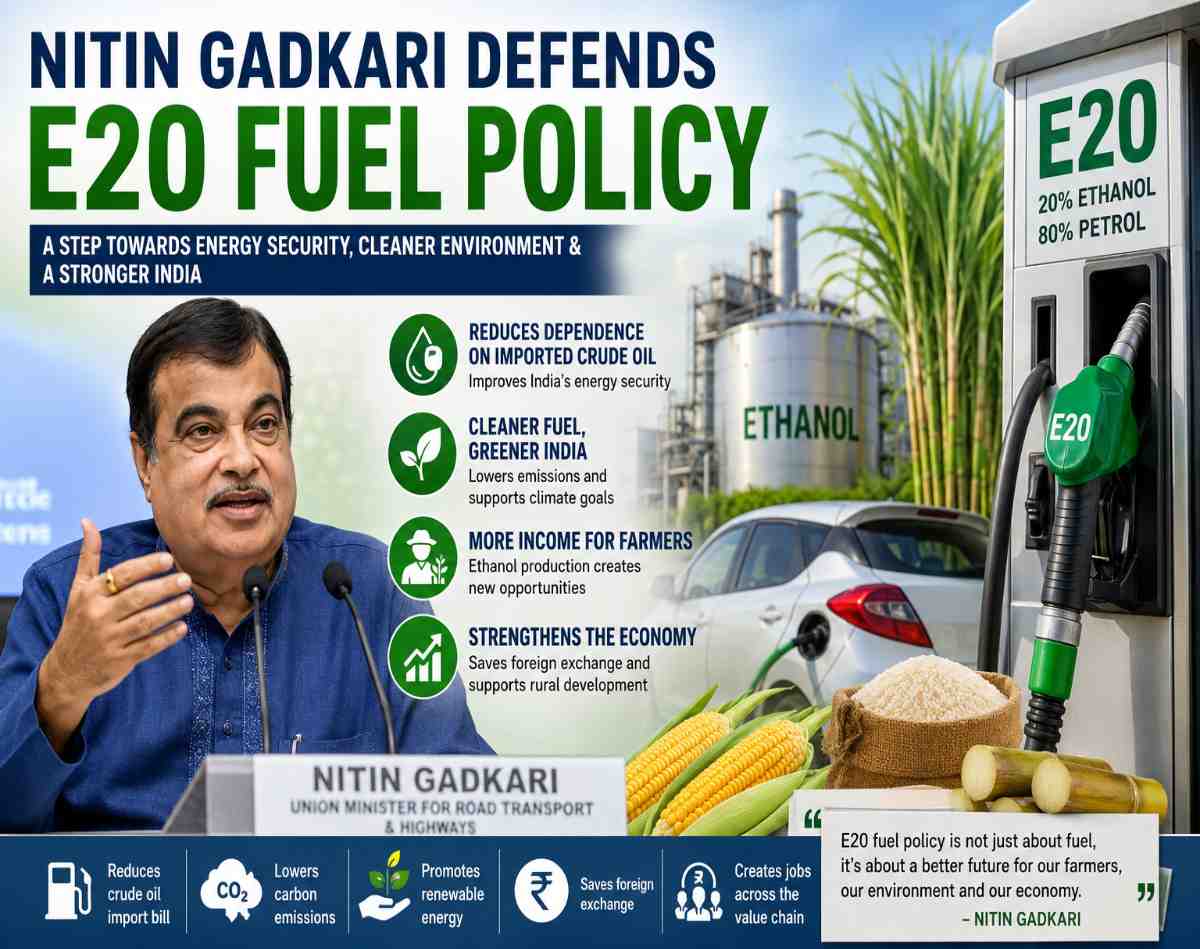
Union Minister Nitin Gadkari highlights the benefits of India's E20 ethanol-blended petrol policy for energy security, farmers, and cleaner transportation.
Nitin Gadkari Defends E20 Fuel Policy: Why India Is Moving Towards Ethanol-Blended Petrol
India’s transition toward cleaner and more sustainable transportation has gained momentum as Union Minister Nitin Gadkari defended the E20 fuel policy, calling it a crucial step toward reducing crude oil imports, supporting farmers, and protecting the environment. The government’s push for 20% ethanol-blended petrol (E20) has sparked discussions among vehicle owners, automobile manufacturers, and environmental experts.
While some consumers have expressed concerns about vehicle compatibility and fuel efficiency, the Centre maintains that the policy is designed to strengthen India’s energy security and reduce dependence on imported fossil fuels. Gadkari emphasized that India spends enormous amounts every year importing crude oil, and increasing ethanol blending can help save foreign exchange while promoting cleaner mobility. For more updates on energy and policy news, visit trusted sources.
The Nitin Gadkari Defends E20 Fuel Policy discussion has become one of the most talked-about topics in the automobile and energy sectors, as millions of vehicle owners want to understand what this transition means for them. For comprehensive coverage of this and other national issues, follow trusted news outlets.
Nitin Gadkari Defends E20 Fuel Policy: What Is E20 Fuel?
E20 fuel is a blend containing 20% ethanol and 80% petrol. Ethanol is a renewable biofuel produced from agricultural crops such as sugarcane, maize (corn), damaged food grains, and surplus rice approved for ethanol production.
Unlike conventional petrol, ethanol is produced domestically, making it an important alternative fuel for reducing India’s reliance on imported crude oil. Countries such as Brazil and the United States have successfully adopted higher ethanol blending levels for many years. India is now accelerating its own ethanol blending programme to improve energy independence and reduce carbon emissions.
Nitin Gadkari Defended the E20 Fuel Policy That
Speaking about the government’s fuel strategy, Nitin Gadkari reiterated that the E20 initiative is not just an environmental programme but also an economic reform. According to the minister, India imports a significant portion of its crude oil requirements every year. These imports place a heavy burden on the country’s economy because international oil prices fluctuate due to global events, geopolitical tensions, and supply disruptions.
By increasing ethanol blending, India aims to:
- Reduce crude oil imports
- Improve national energy security
- Support domestic agriculture
- Reduce air pollution
- Encourage clean mobility
- Lower greenhouse gas emissions
Gadkari also pointed out that ethanol production creates new opportunities for farmers by generating demand for agricultural produce used in biofuel manufacturing.
Understanding India’s Ethanol Blending Programme
India introduced the Ethanol Blended Petrol (EBP) Programme several years ago to gradually increase ethanol content in petrol. The journey has been remarkable:
| Year | Ethanol Blending Percentage | Milestone |
|---|---|---|
| 2014 | Around 1.5% | Initial phase of blending |
| 2018 | Nearly 5% | Steady progress achieved |
| 2022 | Around 10% | Target achieved ahead of schedule |
| 2025 onwards | Targeting 20% (E20) | Nationwide rollout underway |
The government accelerated its timeline after significant improvements in ethanol production capacity and support from sugar mills and grain-based distilleries. The programme forms part of India’s broader clean energy strategy, which includes electric vehicles, biofuels, green hydrogen, compressed biogas, and sustainable transportation.
Why India Wants to Reduce Crude Oil Imports
India is among the world’s largest consumers of petroleum products. However, domestic crude oil production meets only a small share of the country’s total demand. Every year, India spends lakhs of crores of rupees importing crude oil from other countries.
This creates several challenges:
Rising Import Bill
When global crude oil prices increase, India’s import bill also rises significantly.
Forex Pressure
Large-scale crude oil imports require substantial foreign currency payments, affecting forex reserves.
Fuel Price Volatility
International geopolitical conflicts and supply disruptions cause sudden price increases.
Energy Security Risks
Heavy dependence on imported crude oil makes India vulnerable to global market fluctuations.
According to the government, increasing domestic ethanol production can reduce these risks over time.
How Ethanol Supports Indian Farmers
One of the strongest arguments presented by Nitin Gadkari is that ethanol production directly benefits Indian farmers. Instead of relying solely on food markets, farmers gain an additional source of income by supplying crops used in ethanol manufacturing.
Crops Commonly Used for Ethanol Production
Sugarcane • Maize • Broken rice • Surplus food grains • Agricultural biomass (in future technologies)
The government believes this approach helps:
- Increase rural income
- Improve agricultural sustainability
- Reduce dependence on sugar exports
- Strengthen India’s biofuel ecosystem
For sugar mills, ethanol production also provides an alternative revenue stream, reducing financial stress caused by fluctuations in sugar prices.
Environmental Benefits of E20 Petrol
The transition to ethanol-blended fuel is closely linked with India’s climate commitments. Compared to conventional petrol, ethanol burns more cleanly and contributes to lower emissions of harmful pollutants.
Reduced Carbon Emissions
Ethanol is produced from renewable agricultural resources, making it a cleaner alternative to fossil fuels.
Better Air Quality
Lower emissions can contribute to improved urban air quality, especially in cities with high vehicle density.
Lower Greenhouse Gases
Higher ethanol blending supports India’s goals under international climate commitments.
Renewable Energy
Unlike petroleum, ethanol is renewable and can be produced every year through agricultural activities.
Impact of E20 Fuel on Cars and Bikes
One of the biggest questions surrounding the Nitin Gadkari Defends E20 Fuel Policy debate is whether E20 petrol is safe for existing vehicles. As the government expands the availability of ethanol-blended fuel across the country, millions of car and two-wheeler owners want to know if switching to E20 will affect engine performance, fuel efficiency, or maintenance costs.
According to the government and automobile manufacturers, many new vehicles manufactured in recent years are designed or calibrated to be compatible with E20 fuel. However, the experience may vary depending on the age of the vehicle and the manufacturer’s specifications. Vehicle owners are advised to check their owner’s manual or contact the manufacturer to confirm whether their vehicle is E20-compatible.
Nitin Gadkari Defends E20 Fuel Policy: Is E20 Petrol Safe for Older Vehicles?
This has been one of the most discussed topics since the rollout of E20 petrol. Experts point out that older vehicles, especially those designed before E20 compatibility standards were introduced, may not have fuel system components optimized for higher ethanol content.
Potential concerns include:
- Wear and tear of certain rubber or plastic fuel system parts
- Changes in fuel-air mixture affecting engine performance
- Slight differences in fuel economy
- Increased maintenance if incompatible parts are used over long periods
However, this does not mean that every older vehicle will immediately experience problems. The actual impact depends on factors such as the vehicle’s design, engine technology, and maintenance history. The government has stated that the transition to E20 is being implemented gradually to give both manufacturers and consumers enough time to adapt.
Will E20 Fuel Reduce Mileage?
Another common concern among motorists is whether ethanol-blended petrol reduces fuel efficiency. Ethanol contains less energy per litre than petrol, which means vehicles running on higher ethanol blends may experience a small reduction in mileage compared to pure petrol.
The actual difference depends on several factors:
- Engine design
- Driving habits
- Road conditions
- Vehicle maintenance
- Fuel quality
For vehicles specifically engineered for E20, manufacturers aim to minimize any noticeable change in fuel economy through engine optimization and updated calibration.
Common Myths About E20 Petrol
As E20 fuel becomes more widely available, several misconceptions have circulated among the public. Here are the facts behind the most common myths:
Economic Impact of the E20 Fuel Policy on India
The Nitin Gadkari Defends E20 Fuel Policy initiative is not only about cleaner fuel — it is also a major economic strategy. India is one of the world’s largest consumers of petroleum products and imports a significant share of its crude oil. These imports cost the country billions of dollars every year.
By increasing the use of ethanol produced within India, the government aims to reduce dependence on imported oil, strengthen energy security, and create new economic opportunities for farmers and industries.
If implemented successfully, the E20 policy could have a long-term positive impact on India’s economy by reducing fuel import costs, encouraging domestic production, and supporting rural development.
Opportunities for Sugar Mills and Distilleries
The ethanol blending programme has also created new business opportunities for sugar mills and grain-based distilleries. Instead of relying only on sugar production, mills can diversify by producing ethanol for fuel blending.
- Additional revenue streams
- Better financial stability
- Reduced surplus sugar stocks
- Increased investment in biofuel infrastructure
- Job creation in rural and semi-urban areas
How the Automobile Industry Is Preparing
Automobile manufacturers have gradually started producing vehicles that are compatible with E20 fuel. Many newly launched cars and motorcycles are now designed to operate efficiently using ethanol-blended petrol.
Manufacturers have also been working on:
- Updated engine calibration
- Improved fuel system materials
- Enhanced combustion technology
- Flex-fuel engine development
The government has encouraged automobile companies to accelerate the transition so that consumers can comfortably adopt E20 fuel without major concerns.
Global Examples: Countries Using Ethanol-Blended Fuel
India is not the first country to adopt ethanol blending. Several nations have successfully integrated ethanol into their transportation systems.
Brazil
Brazil has one of the world’s most advanced ethanol programmes. Ethanol made from sugarcane has been used for decades, and many vehicles are designed for high ethanol blends or flex-fuel systems.
United States
The US uses ethanol produced primarily from maize. Ethanol-blended petrol is widely available, and many vehicles are compatible with standard ethanol blends.
These international experiences provide valuable lessons for India as it expands its own biofuel programme.
Government’s Long-Term Roadmap
The E20 initiative is part of a broader strategy to transform India’s energy landscape. The government’s long-term vision includes:
- Increasing domestic biofuel production
- Promoting flex-fuel vehicle technology
- Expanding clean transportation options
- Reducing dependence on imported fossil fuels
- Supporting farmers through new agricultural markets
- Strengthening energy security
The E20 policy complements other initiatives such as electric mobility, compressed biogas, green hydrogen, and alternative fuels, reflecting a diversified approach to meeting India’s future energy needs.
Key Takeaways
- India is moving towards 20% ethanol-blended petrol (E20)
- The policy aims to reduce crude oil imports and strengthen energy security
- Ethanol production creates additional income opportunities for farmers
- Newer vehicles are increasingly being designed for E20 compatibility
- The initiative supports cleaner transportation and lower emissions
- Consumer awareness and infrastructure development remain important
- The programme is part of India’s broader renewable energy strategy
Conclusion
The Nitin Gadkari Defends E20 Fuel Policy initiative marks an important milestone in India’s transition towards cleaner and more sustainable transportation. By encouraging the use of ethanol-blended petrol, the government aims to reduce dependence on imported crude oil, strengthen the country’s energy security, support farmers, and promote renewable fuels.
Although questions remain regarding vehicle compatibility, fuel efficiency, and nationwide infrastructure, the government believes these challenges can be addressed through phased implementation, technological advancements, and collaboration with automobile manufacturers.
For consumers, the shift to E20 highlights the importance of understanding their vehicle’s fuel requirements and following manufacturer recommendations. As more E20-compatible vehicles enter the market and ethanol production continues to expand, the policy is expected to play a significant role in India’s long-term energy strategy.
The success of the E20 programme will depend on coordinated efforts by policymakers, automobile companies, fuel retailers, farmers, and consumers. If implemented effectively, it has the potential to reduce fuel import dependence, support rural development, and contribute to a cleaner and more resilient transportation ecosystem.
Frequently Asked Questions
E20 petrol is a fuel blend containing 20% ethanol and 80% petrol. Ethanol is a renewable biofuel produced from agricultural feedstocks such as sugarcane, maize, and approved surplus food grains. The government is promoting E20 as part of its clean energy and energy security strategy.
Union Minister Nitin Gadkari has said that the E20 policy can reduce India’s dependence on imported crude oil, improve energy security, lower greenhouse gas emissions, support Indian farmers through increased demand for ethanol feedstocks, and encourage the use of cleaner renewable fuels.
Not every vehicle is designed for E20 fuel. Many newer cars and motorcycles are manufactured to be E20-compatible, while some older models may not be optimized for higher ethanol blends. Vehicle owners should always read the owner’s manual, check the manufacturer’s recommendations, and contact the authorised service centre if unsure.
Because ethanol contains slightly less energy than petrol, some vehicles may experience a small reduction in fuel economy. However, modern E20-compatible vehicles are designed to minimise this difference through improved engine calibration.
For vehicles specifically designed to use E20 fuel, no major increase in maintenance is generally expected. Owners of older vehicles should follow the manufacturer’s guidance regarding fuel compatibility and servicing.
The programme creates additional demand for crops used in ethanol production, including sugarcane, maize, approved surplus rice, and damaged food grains. This provides farmers with more market opportunities and supports rural incomes.
Ethanol is a renewable fuel that can help reduce dependence on fossil fuels and contribute to lower greenhouse gas emissions. The government considers ethanol blending one of several measures aimed at supporting cleaner transportation and environmental sustainability.
About the Author







2 thoughts on “Nitin Gadkari Defends E20 Fuel Policy”