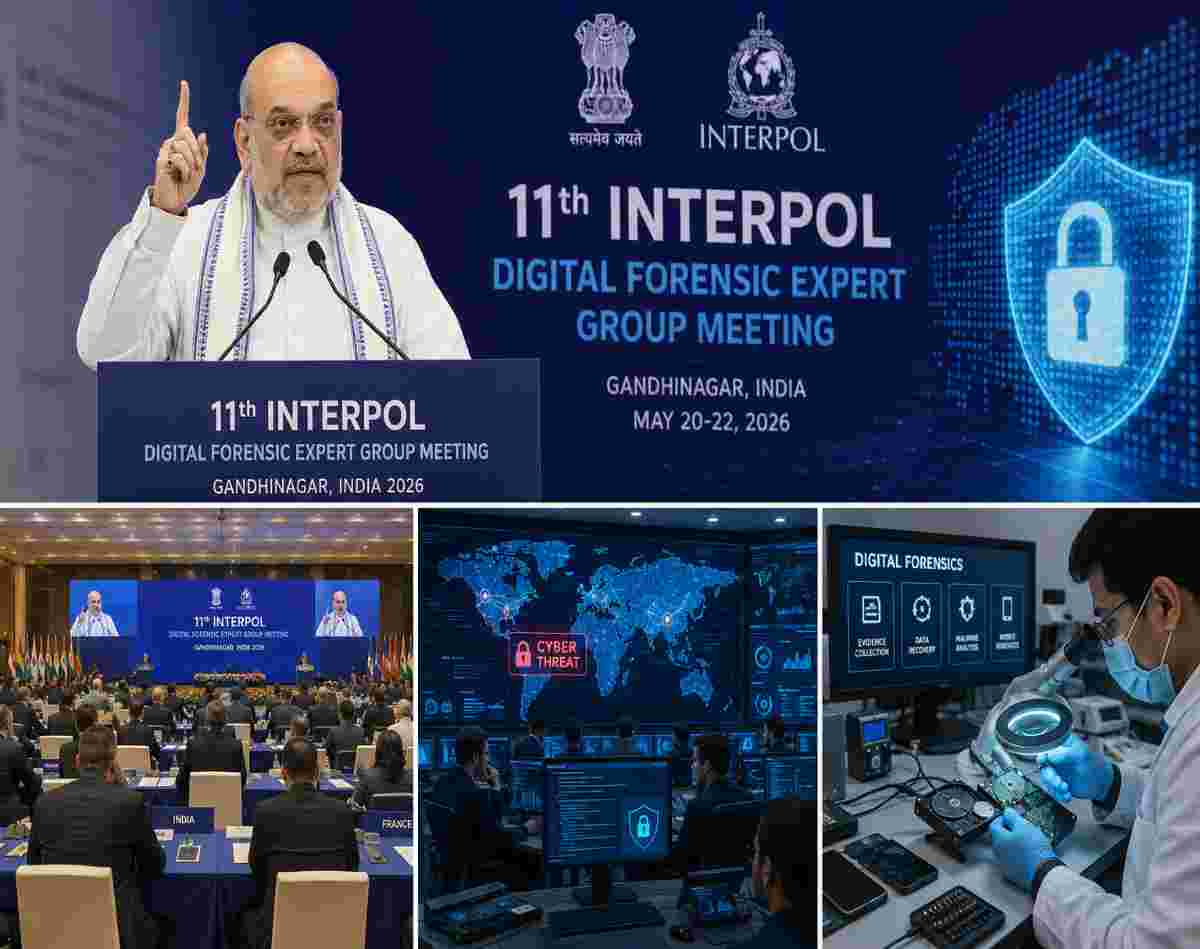
Amit Shah addresses the INTERPOL Digital Forensics Expert Group Meeting, highlighting India's growing leadership in cybersecurity and digital forensics.
Amit Shah INTERPOL Meeting 2026: India’s Growing Cybersecurity Role Takes Center Stage
India hosts the 11th INTERPOL Digital Forensics Expert Group Meeting in Gandhinagar, unveiling AI-powered Centres of Excellence and a bold vision for global cybercrime cooperation.
Key Takeaway
The Amit Shah INTERPOL Meeting 2026 has emerged as one of the most significant international cybersecurity events of the year. Specifically, India hosted the 11th INTERPOL Digital Forensics Expert Group Meeting in Gandhinagar, Gujarat, bringing together law enforcement officials, forensic experts, and cybersecurity specialists from dozens of countries to shape the future of digital crime investigations.
In an era where cybercrime has become one of the fastest-growing global security threats, international cooperation has never been more important. Recognising this challenge, India took a decisive step toward becoming a global leader in digital security by hosting this high-profile event. Notably, the conference was inaugurated by Union Home Minister Amit Shah and spotlighted India’s expanding influence in combating cyber threats through artificial intelligence, advanced digital forensics, and cross-border intelligence sharing.
As cyberattacks grow increasingly sophisticated, the INTERPOL Meeting 2026 focused on leveraging AI, advanced forensic technologies, and international intelligence-sharing mechanisms to combat digital crimes effectively. Moreover, India’s decision to host this prestigious gathering reflects the country’s rapidly expanding technological capabilities and its commitment to ensuring a safer digital future.
Amit Shah INTERPOL Meeting 2026: Why It Matters for Global Cybersecurity
The digital revolution has reshaped nearly every aspect of modern life. As a result, governments, businesses, healthcare systems, and financial organisations now depend heavily on interconnected digital networks. While this transformation has improved efficiency and convenience, it has simultaneously created vast opportunities for cybercriminals.
Today’s cyber threats span a wide and dangerous spectrum. Specifically, financial fraud, online banking scams, identity theft, ransomware attacks, data breaches, cryptocurrency-related crimes, child exploitation on digital platforms, dark web criminal activities, and AI-enabled cyberattacks all pose serious risks to individuals, businesses, and nations alike.
Unlike traditional crimes, cyber offences often cross national borders within seconds. For instance, a hacker sitting in one country can target victims across multiple continents simultaneously. Consequently, this borderless nature of cybercrime makes international cooperation absolutely essential. Furthermore, the Digital Forensics Expert Group serves as a critical platform where member countries exchange knowledge, share best practices, develop investigation standards, and improve coordination for handling complex cybercrime investigations.
Amit Shah INTERPOL Meeting 2026: India’s Growing Leadership in Global Cybersecurity
Over the past decade, India has rapidly transformed into one of the world’s leading digital economies. Specifically, initiatives such as Digital India, widespread internet access, digital banking, UPI payments, Aadhaar-enabled services, and expanding cloud infrastructure have accelerated digital adoption across the country. However, this rapid digital growth has simultaneously increased the risk of cyberattacks.
Millions of Indians now rely daily on online banking, UPI payment platforms, e-commerce websites, government digital services, healthcare portals, educational platforms, cloud storage, and social media applications. As digital transactions continue to rise every year, protecting sensitive information has become a national priority.
In response to these challenges, the Government of India has invested heavily in national cybersecurity infrastructure, digital forensic laboratories, AI-powered investigation tools, cybercrime reporting mechanisms, police modernisation, cyber awareness campaigns, and capacity building for investigators. Consequently, the INTERPOL meeting provided India with an ideal opportunity to showcase these advancements before an international audience.
Amit Shah’s Vision: Technology as the Weapon Against Cybercrime
During the inauguration, Union Home Minister Amit Shah emphasised that cybercrime is no longer a problem limited to individual countries. Instead, it has become a global challenge requiring collective action. Furthermore, he highlighted that criminals are increasingly using advanced technologies such as artificial intelligence, encrypted communication platforms, cryptocurrency, and anonymous networks to commit sophisticated digital crimes.
Amit Shah’s Key Message
“Technology should become the biggest weapon in the fight against cybercrime, rather than allowing criminals to exploit technological advancements. Future policing will depend on artificial intelligence, machine learning, big data analytics, and international intelligence sharing.”
According to Amit Shah, governments must continuously upgrade their investigative capabilities. Moreover, he stressed that the future of policing depends on real-time intelligence sharing, AI-driven investigations, digital evidence analysis, and strong international cooperation. Additionally, he reiterated India’s commitment to working closely with INTERPOL member countries to improve cybercrime investigations and enhance information sharing across borders.
Three New Centres of Excellence Announced
One of the biggest highlights of the INTERPOL meeting was the announcement of three advanced Centres of Excellence designed to significantly improve India’s cyber investigation capabilities.
1. AI-Based Cybercrime Investigation
Artificial Intelligence is rapidly transforming both cybercrime and cybersecurity. On one hand, criminals use AI to automate attacks, generate convincing phishing emails, create fake identities, and develop sophisticated malware. On the other hand, India’s new centre will deploy AI-powered tools for detecting suspicious online activity, identifying criminal networks, analysing large evidence volumes, predicting cyberattack patterns, and supporting investigators with automated intelligence analysis.
- Automated suspicious activity detection
- Criminal network identification
- Predictive cyberattack pattern analysis
- Automated intelligence processing
2. Financial Cybercrime Investigation
Financial fraud remains one of India’s fastest-growing cyber threats. Annually, thousands lose money through UPI fraud, credit card scams, online banking fraud, fake investment schemes, cryptocurrency scams, and QR code fraud. Accordingly, this centre will focus on faster financial fraud detection, tracking stolen funds, digital transaction analysis, cryptocurrency investigations, and international financial intelligence cooperation.
- Real-time fraud detection systems
- Stolen fund tracking and recovery
- Cryptocurrency investigation capabilities
- Cross-border financial intelligence sharing
3. Advanced Digital Forensics Research
Digital evidence plays a vital role in modern criminal investigations. Specifically, today’s investigators must analyse evidence from smartphones, computers, hard drives, CCTV systems, cloud servers, email accounts, social media platforms, and IoT devices. To address this, the new research centre will develop advanced forensic techniques for recovering, preserving, and analysing digital evidence while maintaining legal standards required for court proceedings.
- Advanced data recovery techniques
- Cloud and IoT evidence analysis
- Court-admissible evidence standards
- Deleted file recovery capabilities
India’s First Indigenous Cyber Forensic Investigation Van
Another landmark announcement was the introduction of India’s first indigenous Cyber Forensic Investigation Van. Essentially, this mobile forensic laboratory allows investigators to analyse digital evidence directly at crime scenes, eliminating the need to transport devices to specialised laboratories.
The vehicle is equipped with advanced tools for mobile phone forensics, computer forensic imaging, data recovery, network traffic analysis, digital evidence preservation, password recovery, malware analysis, and secure evidence storage. As a result, this innovation significantly reduces investigation time while ensuring critical digital evidence is protected from tampering. Moreover, it is expected to support police departments across India, especially in complex cybercrime cases requiring immediate forensic examination.
Strengthening Media Forensics Against Deepfakes
The rapid rise of misinformation, manipulated videos, and AI-generated deepfakes has created unprecedented challenges for governments worldwide. In response, India is strengthening its Media Forensics Centre to identify and analyse digitally altered content, including deepfake videos, edited photographs, fake audio recordings, AI-generated content, and fabricated digital evidence.
With artificial intelligence making it easier to create realistic fake content, advanced forensic tools have become essential for verifying digital media authenticity. Consequently, these capabilities will support criminal investigations, election security, financial fraud detection, and national security operations.
The Rising Threat of Ransomware Attacks
Among the major topics discussed was the growing danger of ransomware. Essentially, this malicious software encrypts victims’ files or systems, with attackers demanding ransom payments, often in cryptocurrency. To date, ransomware has affected government departments, hospitals, educational institutions, manufacturing companies, banks, airlines, energy providers, and small businesses worldwide.
Experts stressed the importance of regular data backups, strong cybersecurity practices, employee awareness training, timely software updates, international intelligence sharing, and rapid incident reporting. Accordingly, India has been strengthening its preparedness by enhancing cyber monitoring systems, expanding forensic capabilities, and encouraging organisations to adopt stronger cybersecurity frameworks.
How These Initiatives Benefit Citizens and Businesses
For Citizens
- Better protection against online banking fraud
- Faster investigation of cybercrime complaints
- Improved safeguards for personal data
- Greater trust in digital payment platforms
- Enhanced protection from identity theft
For Businesses
- Stronger customer information protection
- Reduced financial losses from cyberattacks
- Improved cybersecurity compliance
- Better incident response capabilities
- Increased confidence in India’s digital economy
Amit Shah INTERPOL Meeting 2026: Preparing for the Future of Cybersecurity
Experts at the conference agreed that cyber threats will continue evolving alongside quantum computing, artificial intelligence, IoT, and 5G networks. To remain prepared, governments and organisations must focus on continuous cybersecurity investment, forensic research and innovation, international collaboration, training skilled professionals, public awareness on safe online practices, and adoption of advanced AI-driven security solutions.
India’s recent initiatives indicate a long-term strategy aimed at building a secure digital ecosystem capable of responding to both current and future cyber threats. Ultimately, by combining technology with policy reforms and global collaboration, India is positioning itself to address the increasingly complex nature of cybercrime.
Conclusion
The Amit Shah INTERPOL Meeting 2026 marks a significant milestone in India’s journey toward becoming a global cybersecurity leader. However, as cyber threats continue to grow in complexity and scale, no nation can address them in isolation. Therefore, international cooperation, technological innovation, and robust digital forensic capabilities are now essential components of modern law enforcement.
India’s investments in AI-powered investigation tools, cyber forensic research, financial cybercrime detection, and advanced digital evidence analysis will strengthen the country’s ability to respond to emerging threats while supporting global security efforts. Moreover, these developments promise improved protection for citizens and reinforce confidence in India’s digital economy for businesses. Meanwhile, the international community recognises India’s growing role as a reliable partner in building a safer cyberspace.
Frequently Asked Questions
What is the INTERPOL Digital Forensics Expert Group Meeting 2026?
It is an international conference held in Gandhinagar, India, where experts from INTERPOL member countries discuss cybercrime investigations, digital evidence analysis, forensic technologies, and global cooperation against cyber threats.
What did Amit Shah announce at the INTERPOL Meeting 2026?
Amit Shah announced three new Centres of Excellence focused on AI-based cybercrime investigation, financial cybercrime analysis, and advanced digital forensics research. He also unveiled India’s first indigenous Cyber Forensic Investigation Van.
Why is India hosting the INTERPOL meeting significant?
Hosting the event highlights India’s growing cybersecurity expertise, expanding digital forensic infrastructure, and commitment to international law enforcement collaboration against cybercrime.
How will these cybersecurity initiatives benefit Indian citizens?
These initiatives will improve investigation speed, reduce online banking fraud, strengthen data security, enhance trust in UPI and digital payment platforms, and provide better protection against identity theft and online scams.
What role does AI play in India’s cybersecurity strategy?
AI powers automated malware detection, real-time threat monitoring, behavioural analysis of cybercriminals, fraud detection in financial transactions, and advanced digital evidence classification, making investigations faster and more accurate.
About the Author