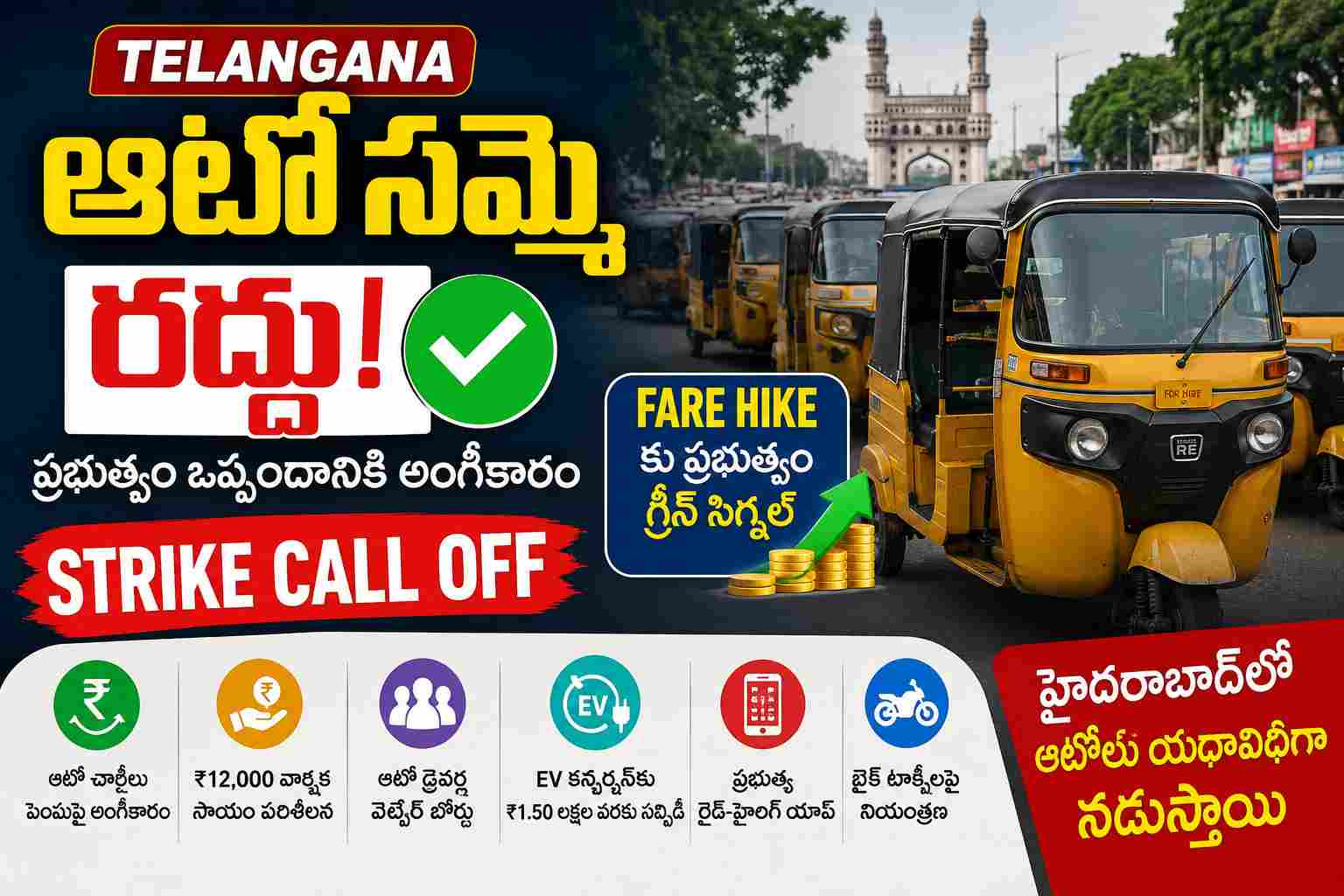
Telangana Auto Strike రద్దు.. Fare Hikeకు ప్రభుత్వం అంగీకారం. హైదరాబాద్లో ఆటోలు యథావిధిగా నడవనున్నాయి.
Telangana Auto Strike Called Off: Government Agrees Fare Revision, Welfare Board and Rs 1.50 Lakh EV Support — Full Update Explained
Auto drivers across Telangana have called off their indefinite strike, which they had planned to begin on August 24. The unions took this decision at the very last moment, after the state government responded positively to their core demands. Driver organisations representing autos, cabs and school vans had announced the agitation to press for a long-pending fare revision, yearly financial assistance, a dedicated welfare board and several other measures affecting their livelihoods.
Talks between union representatives and Transport Minister Ponnam Prabhakar produced the breakthrough, just hours before the proposed strike start. With the administration agreeing in principle to revise auto fares and take forward welfare steps, the union leaders withdrew the call and kept autos on the road.
As a result, lakhs of commuters in Hyderabad and other parts of the state who depend on autos daily will continue to receive normal services without any disruption. For drivers, however, several announcements offer hope — although most remain proposals awaiting formal government orders rather than delivered benefits.
In This Article
- Key highlights at a glance
- Telangana Auto Strike timeline of events
- Telangana Auto Strike: what exactly happened?
- Why drivers announced the strike
- Auto fare hike: what was agreed
- Current meter rates: passenger advisory
- Rs 12,000 annual assistance explained
- Welfare board for auto drivers
- EV conversion support up to Rs 1.50 lakh
- Government ride-hailing app plan
- Bike taxi regulation
- Confirmed vs pending decisions
- Impact on commuters and drivers
- Official statements
- What happens next
- Frequently asked questions
Key Highlights at a Glance
- The unions have withdrawn the indefinite Telangana auto strike that they planned from August 24.
- Union representatives and Transport Minister Ponnam Prabhakar held talks hours before the strike was to begin.
- The government has accepted, in principle, that auto fares need revision — charges have remained unchanged since 2012.
- However, no new fares exist yet; officials will fix final rates only after a stakeholder report.
- The cabinet will examine the Rs 12,000 annual assistance demand, keeping the state’s financial position in view.
- Similarly, the welfare board idea received a positive response; both sides will work out its modalities.
- In addition, up to Rs 1.50 lakh now supports converting old petrol/diesel autos into electric autos within the Hyderabad CURE Area.
- The government also plans a ride-hailing app similar to Ola and Uber, with IT department cooperation.
- Besides this, a decision on mandatory yellow number plates for bike taxis remains under consideration.
- Finally, departments and unions will meet on September 1.
Telangana Auto Strike Timeline of Events
First, auto, cab and school van driver associations announced an indefinite strike from August 24 over fare revision and welfare demands.
Then, the government invited union representatives for talks with Transport Minister Ponnam Prabhakar.
After a positive response on multiple demands, the unions called off the strike. Consequently, autos operated normally across the state.
Next, union representatives and labour and transport department officials will meet to discuss the welfare board and related matters.
Telangana Auto Strike: What Exactly Happened?
The build-up to August 24
Tension had been growing in Telangana’s transport sector for some time. Driver associations raised a set of unresolved issues with the government again and again. When those demands did not move forward, the unions announced an indefinite strike from August 24. The call covered auto drivers primarily, along with cab and school van operators, and threatened to halt a large share of the state’s last-mile transport.
Last-minute talks at the negotiating table
With only hours left before the shutdown, the government moved quickly to defuse the situation. Officials invited union representatives for discussions with Transport Minister Ponnam Prabhakar. During these talks, the government signalled agreement in principle on the central issue — revising auto fares — and responded positively to several welfare demands as well.
Why the unions withdrew the strike
Satisfied with this response, the unions decided late in the process to withdraw the strike. As a result, autos continued to run as usual on August 24 and beyond. Consequently, students heading to schools and colleges, office-goers, and travellers moving to and from railway stations avoided the disruption that an indefinite strike would have caused, especially during morning and evening rush hours.
Why Drivers Announced the Strike: The Eight Core Demands
Driver groups had taken up multiple problems with the government over recent months. Therefore, the strike call centred on the following demands:
- An increase in auto fares, which remained unchanged since 2012.
- Annual financial assistance of Rs 12,000 per auto driver, as per an election-time promise.
- A separate welfare board for auto drivers.
- Accident insurance cover of Rs 5 lakh.
- Regulation of bike taxi services operating through apps.
- Minimum income security for auto drivers.
- A government-run ride-hailing application.
- Financial assistance to convert old petrol and diesel autos into electric vehicles.
Against this backdrop, the unions fixed August 24 as the strike date. However, the government’s willingness to engage — and to act on several of these points — pulled the state back from a full-scale transport shutdown.
Auto Fare Hike: What the Government Actually Agreed To
The single biggest point of discussion in the talks concerned the auto fare revision. The government acknowledged that authorities have not revised auto charges in Telangana since 2012, even though fuel prices, vehicle maintenance costs, repair expenses and other running costs have risen substantially during this period.
However, the government did not announce new rates at the meeting. Instead, it chose a step-by-step process: first, consultations with the concerned stakeholders; next, a report based on those discussions; finally, a decision on the new charges according to that report.
So, the fare hike remains, for now, an accepted principle rather than a notified change. Passengers and drivers alike must wait for the official order to learn the minimum fare, the per-kilometre rate, whether meters will become compulsory, and how shared auto charges will work. These points form part of the guidelines the transport department needs to spell out when it releases the new fare structure.
Why the process matters
A stakeholder-based review means data and consultation will shape the eventual increase, rather than a sudden announcement. At the same time, no official number exists today — which brings us to the advisory every passenger should know.
Current Meter Rates: Advisory for Passengers
Until officials notify the new meter rates, the existing fare rules continue to apply. In practical terms, passengers should pay according to current meter charges, because no legal basis exists yet for collecting anything higher.
Once the notification arrives, three specifics will show the impact on a passenger’s daily travel budget: the revised minimum charge, the per-kilometre rate, and the rules for shared autos. Currently, nobody knows any of these figures.
Rs 12,000 Annual Assistance: Promise vs Present Position
The second major demand concerned yearly financial assistance of Rs 12,000 for auto drivers. Driver associations pointed out that this amount matches an election-time promise, and they pressed the government to implement it as committed.
In response, Minister Ponnam Prabhakar assured the unions that he would discuss the matter with the Chief Minister, the Deputy Chief Minister and other ministers, and that the government would take a positive decision while keeping the state’s financial position in view.
Clearly, this is not yet a sanctioned scheme. So far, the government has announced no eligibility criteria, application process or payment schedule. The commitment now stands at the level of a cabinet-level examination, and drivers will get real clarity only when the cabinet takes a formal decision after those discussions.
Welfare Board for Auto Drivers: Positive Response, Process Ahead
Demand number three — a dedicated welfare board for auto drivers — also drew a favourable response from the government. Following the talks, union representatives will sit with officials of the transport department and the labour department to work out the next steps.
If the government constitutes the board, it could serve as the institutional channel through which various welfare programmes and support schemes reach auto drivers in an organised manner. Meanwhile, both sides expect the framework, composition and powers of the proposed board to figure in the September 1 discussions between the departments and union representatives.
Electric Auto Conversion: Support of Up to Rs 1.50 Lakh
A concrete announcement from the talks concerns cleaner mobility. The government stated it will provide financial assistance of up to Rs 1.50 lakh for retrofitting old petrol and diesel autos into electric vehicles within the Hyderabad CURE Area.
Alongside this, according to the minister, the government has already decided to extend a subsidy for purchases of new electric autos. For drivers, shifting to an electric auto could significantly cut daily fuel expenditure going forward — one of the recurring cost pressures behind their fare demand. Therefore, interested drivers should watch for the detailed guidelines that specify eligibility and the application route under the retrofitting scheme.
Government Ride-Hailing App: A State Answer to Ola and Uber
The talks produced another notable announcement: a plan for a government-run ride-hailing aggregator app modelled on platforms like Ola and Uber. Transport Minister Ponnam Prabhakar said the IT department would cooperate in developing the app.
Through this platform, passengers could book autos while drivers gain a digital channel for rides under government oversight. However, several essentials remain undisclosed: the app’s name, its launch timeline, and how fares or commissions on it will work. Until those details emerge, the project remains at the proposal-and-development stage.
Bike Taxi Regulation: Yellow Plate Decision Pending
The talks also covered bike taxis operating through platforms such as Rapido, Ola and Uber. The government indicated that it intends to bring tighter control over bike taxi services carrying passengers.
Specifically, it is considering a proposal to make yellow number plates mandatory for bikes used to transport passengers. According to the government, it will take a decision on this measure — so no rule stands in force yet. If officials implement it, the move would formalise the bike taxi segment and bring it under clearer regulatory oversight, an outcome driver unions had sought as part of regulating app-based services.
Confirmed vs Pending: Where Each Decision Stands
To avoid confusion, here we separate what is officially settled from what still awaits a government decision.
| Item | Latest Position | Status |
|---|---|---|
| Auto strike from August 24 | Unions withdrew it after ministerial talks | CONFIRMED |
| Fare revision in principle | Government accepted it; acknowledged fares unchanged since 2012 | CONFIRMED |
| New fare rates | Officials await the stakeholder report and final decision | PENDING |
| Rs 12,000 annual assistance | Cabinet to examine it with state finances in view | PENDING |
| Welfare board | Positive response; both sides to discuss modalities | PENDING |
| EV retrofitting support | Government announced up to Rs 1.50 lakh for Hyderabad CURE Area | ANNOUNCED |
| New electric auto purchase subsidy | Minister confirmed the decision | DECIDED |
| Ride-hailing app | Planned with IT department; details awaited | PROPOSED |
| Bike taxi yellow plates | Decision awaited; no rule in force yet | PENDING |
| September 1 meeting | Departments plus union representatives to discuss welfare board and related matters | SCHEDULED |
Settled So Far
- Unions withdrew the strike — autos run normally
- Fare revision agreed in principle
- Rs 1.50 lakh EV conversion aid announced (CURE Area)
- Subsidy decision for new e-autos
- September 1 meeting scheduled
Still Awaiting Decisions
- New fare chart and meter rates
- Rs 12,000 assistance approval
- Welfare board structure
- Rs 5 lakh accident insurance scheme
- App name, launch date and pricing
- Yellow plate mandate for bike taxis
What This Means for Commuters and Drivers
For commuters
For daily commuters, the immediate effect brings relief and continuity. Schoolchildren, college students, employees and rail travellers in Hyderabad — the groups who faced serious difficulty had the indefinite strike gone ahead — can continue to rely on autos, including during the busy morning and evening hours when autos carry much of the city’s short-distance traffic.
The open question, however, concerns cost. Because the government has only agreed to review fares, travel today still runs on old-rate rules. Only the official publication of the new rate card will reveal any additional burden on the household budget.
Telangana Auto Strike: For Drivers
Drivers, meanwhile, have gained a negotiated path forward instead of a confrontation. The fare revision process addresses their core income complaint — frozen tariffs against rising costs. Over time, the EV support could lower their biggest running expense, although the retrofitting benefit applies specifically within the CURE Area limits of Hyderabad.
At the same time, drivers should calibrate their expectations: the Rs 12,000 assistance, insurance cover, welfare board benefits and the booking app all remain promises in motion, not money or services delivered. Their realisation depends on the cabinet deliberations and the September 1 round of talks.
Official Statements from the Talks
Transport Minister Ponnam Prabhakar led the discussions for the government side. According to the information issued after the meeting, he made the following points:
Key assurances from the minister
- Auto fares in Telangana have seen no increase since 2012; the government will decide on new charges after discussing with concerned authorities and obtaining a report.
- On the Rs 12,000 annual assistance, the government will take a positive decision after discussions with the Chief Minister, Deputy Chief Minister and other ministers, considering the state’s financial condition.
- The IT department will cooperate in developing a ride-hailing aggregator app under government auspices.
- The government has announced support of up to Rs 1.50 lakh for retrofitting old diesel and petrol autos into EVs in the Hyderabad CURE Area, and it has already decided to provide a subsidy for purchasing new electric autos.
Together, these statements form the factual basis of the strike withdrawal and define the roadmap the unions have agreed to wait for.
What Happens Next?
The September 1 meeting agenda
The strike may be over, but the issue remains far from fully resolved. The next confirmed step comes on September 1, when union representatives will meet officials from the labour and transport departments. Observers expect the welfare board and related implementation matters to feature prominently there, and participants may fix procedures and timelines during the discussions.
Decisions still awaited
On fares, the ball moves next to the consultation process: once stakeholders finish consultations and submit the report, the government will take the final call on charges. Similarly, the Rs 12,000 assistance awaits its turn in cabinet-level discussions with the Chief Minister and Deputy Chief Minister. Decisions on the aggregator app’s launch details and the yellow plate mandate for bike taxis also remain pending. In short, drivers can expect the next meaningful update after the September 1 meeting and the official announcements that follow.
Frequently Asked Questions
Has the Telangana auto strike been cancelled?
Have auto fares been increased in Telangana?
What rates should passengers pay right now?
Will auto drivers get the Rs 12,000 annual assistance?
How much support is offered for converting autos into EVs?
Is the Telangana government launching its own auto booking app?
What is happening with bike taxi regulation?
When is the next major update expected?
Conclusion
Telangana stepped back from an indefinite auto strike at the eleventh hour, after Transport Minister Ponnam Prabhakar’s talks with unions produced a positive response on fares, welfare and future-ready measures. Consequently, commuters get uninterrupted services, while drivers gain a defined roadmap — fare revision via a stakeholder report, cabinet-level examination of the Rs 12,000 assistance, a welfare board on the agenda, Rs 1.50 lakh EV conversion support and a planned state-run booking app. Still, none of the headline numbers has reached final form yet. The September 1 meeting and the official notifications that follow will show how much of this promise turns into policy.
About the Author

2 thoughts on “Telangana Auto Strike”