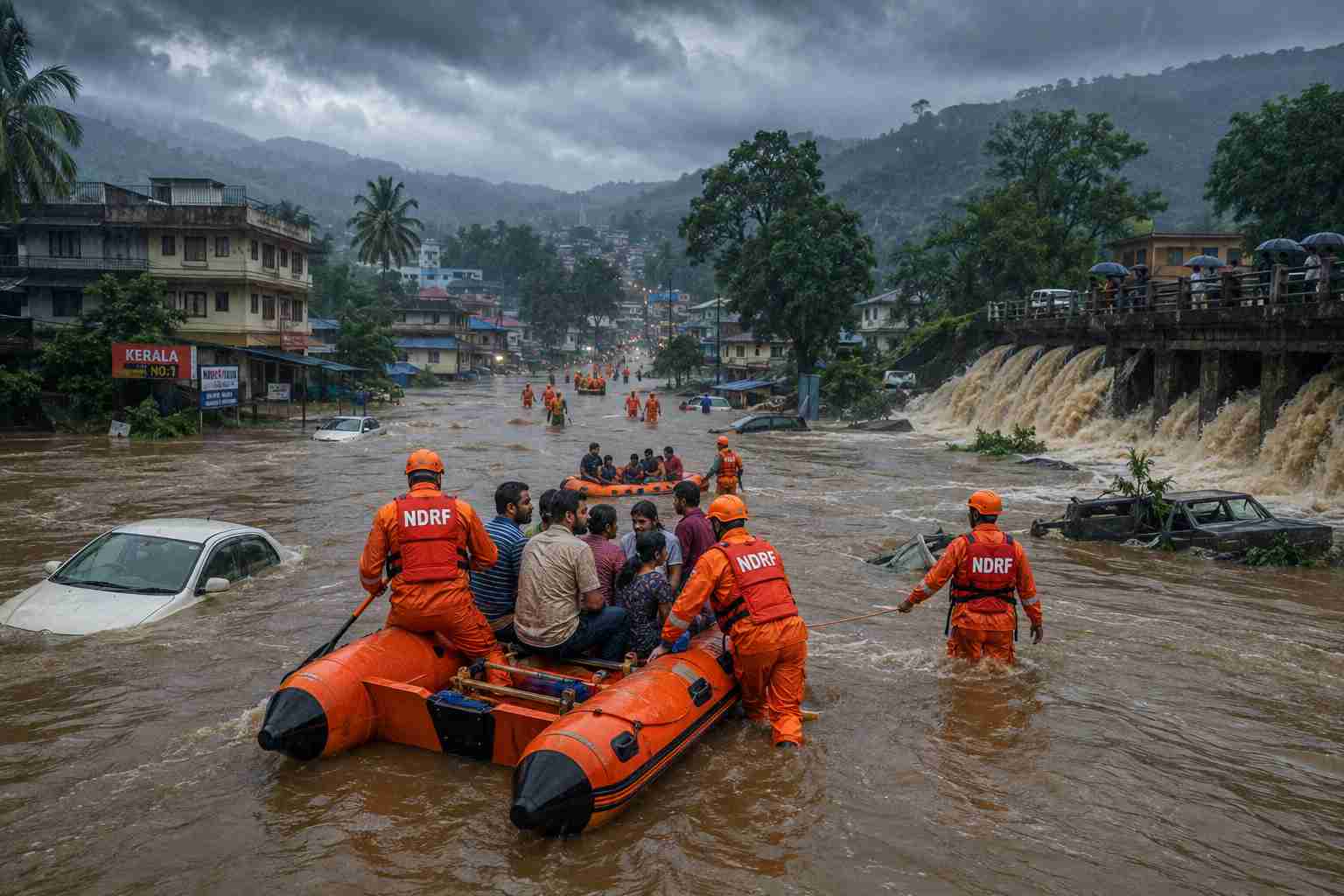
Flooded streets in Kerala after heavy monsoon rain with rescue teams responding under IMD Red Alert
Kerala Heavy Rain & Flood Updates 2026: IMD Issues Red Alert as Torrential Rains Batter the State
Continuous downpours trigger flooding, waterlogging and landslide warnings across multiple districts. NDRF and SDRF teams remain deployed as the state strengthens emergency preparedness.
- Kerala Heavy Rain & Flood Situation Overview
- IMD Red Alert: Which Districts Are Affected?
- Flood Situation Worsens in Low-Lying Areas
- High Landslide Risk in Hilly Districts
- NDRF & SDRF Rescue Operations Intensify
- Relief Camps Open Across Affected Districts
- Kerala Heavy Rain & Flood Road, Rail & Air Travel Disruptions
- District-Wise Rainfall Situation
- Reservoir Levels Under Close Watch
- Impact on Agriculture, Tourism & Business
- Public Health Concerns After Flooding
- Climate Change & Extreme Rainfall Events
- Public Safety Advisory & Emergency Helplines
- Kerala Heavy Rain & Flood Long-Term Flood Management Strategies
- Kerala Rain & Flood FAQs
Kerala Heavy Rain & Flood Situation Overview
Yet again, torrential monsoon rain has placed Kerala at the centre of intense weather activity. Multiple districts are battling flooding, waterlogging, and landslides as continuous downpours disrupt daily life. IMD has issued Red Alerts for several districts after rivers overflowed and reservoir levels rose dangerously. Moreover, fresh landslides in hilly terrain remain a serious concern.
According to the latest Kerala heavy rain and flood updates, rescue teams and district administrations are on high alert. Meanwhile, schools across several districts have been closed and transport services temporarily halted. Furthermore, officials have advised residents in low-lying areas to move to safer locations. This season, the southwest monsoon has remained unusually active over the state, dumping extremely heavy rainfall across many parts of Kerala.
According to weather officials, the current spell of rain will continue for the next few days. Meanwhile, officials are closely monitoring vulnerable locations around the clock. Consequently, emergency preparedness has been strengthened to handle any situation that may arise in the coming hours.
IMD Red Alert: Which Districts Are Affected?
According to the latest IMD bulletin, extremely heavy rainfall exceeding 20 centimetres is expected in isolated places. Consequently, authorities have issued Red Alerts in several districts. Orange and Yellow Alerts have also been issued for neighbouring districts where heavy rainfall is likely to continue.
Typically, officials issue a Red Alert when exceptionally heavy rainfall is expected. Such an alert requires immediate preparedness and possible evacuation from flood-prone areas. Therefore, local administrations have advised people to avoid unnecessary travel, particularly in regions vulnerable to flooding and landslides.
According to meteorologists, the intense rainfall is driven by a strong monsoon system over the Arabian Sea. These conditions continue to push moisture-laden winds towards Kerala’s western coast. Additionally, warmer ocean temperatures and higher atmospheric moisture levels have intensified rainfall activity this season.
- First, a Red Alert signals extremely heavy rainfall (over 20 cm) in isolated places – Wayanad, Idukki, Pathanamthitta, Kottayam, Ernakulam
- Next, an Orange Alert signals very heavy rainfall (11-20 cm) – Kozhikode, Kannur, Malappuram, Thrissur
- Then, a Yellow Alert signals heavy rainfall (7-11 cm) – Palakkad, Alappuzha, Thiruvananthapuram, Kollam
- Finally, alert validity runs for the next 48 hours, with all alerts subject to change based on fresh IMD bulletins
Flood Situation Worsens in Low-Lying Areas
With continuous rainfall, water levels in rivers, canals, and reservoirs have risen significantly across Kerala. In many areas, roads remain submerged, making transportation extremely difficult for commuters. Several low-lying residential colonies have reported water entering homes. Consequently, families have temporarily shifted to relief camps established by local authorities.
Meanwhile, urban areas have also experienced severe waterlogging due to the heavy rainfall. Traffic movement has slowed down, and normal business activities have been disrupted. Meanwhile, emergency workers are removing fallen trees, restoring electricity, and assisting stranded residents wherever necessary.
Officials are closely monitoring major dams and reservoirs as inflow continues to rise. Nevertheless, authorities may release water from certain reservoirs if storage levels increase further. Hence, residents living downstream should remain alert and follow official announcements regarding dam releases.
High Landslide Risk in Hilly Districts
Currently, one of the biggest concerns during Kerala’s monsoon season is the increasing risk of landslides in hilly districts. This relentless rainfall has weakened soil stability in mountainous regions, making landslide-prone areas extremely dangerous.
Therefore, residents living near hillsides should remain vigilant. They should immediately report any signs of danger, including cracks on the ground, leaning trees or electric poles, unusual water seepage, small soil movements, and sudden changes in stream water levels.
- Watch for cracks or fissures appearing on the ground or on walls
- Similarly, trees or electric poles leaning at unusual angles
- Also, unusual water seepage or muddy water from slopes
- Additionally, small soil movements or falling debris
- Meanwhile, sudden increase or decrease in stream water levels
- Above all, rumbling sounds or unusual noise from hillsides
Meanwhile, disaster response teams now stand positioned in vulnerable districts to respond quickly in case of emergencies. Furthermore, officials have declared schools and colleges closed in several affected districts to ensure student safety. Many institutions have shifted to online classes wherever possible.
NDRF & SDRF Rescue Operations Intensify
As the heavy monsoon spell continues across Kerala, rescue agencies and state authorities have intensified relief operations in flood-affected areas. Emergency teams are working around the clock to evacuate stranded residents, provide essential supplies, and restore normalcy.
Teams Deployed to Vulnerable Regions
In particular, NDRF, SDRF, Fire and Rescue Services, Police, and local administration have deployed teams to vulnerable regions. Moreover, boats, life jackets, rescue equipment, and emergency medical teams have been mobilised to assist people living in flood-prone areas.
Supplies Reach Flood-Affected Families
As part of the rescue drive, teams are using inflatable boats to reach people trapped in waterlogged neighbourhoods. Every rescued victim is being transported safely to relief camps. In addition, emergency responders are distributing drinking water, food packets, medicines, baby food, blankets, and essential household supplies. Medical teams stationed at relief camps are providing healthcare services, especially for elderly people, children, and those with chronic illnesses.
- Relief camps are providing drinking water and food packets
- Additionally, medicines and baby food
- Moreover, blankets and essential household supplies
- Furthermore, emergency medical teams at relief camps
- In particular, special care for elderly, children and patients with chronic illness
- Finally, 24-hour district emergency control rooms for faster coordination
In the meantime, state authorities have instructed district collectors to maintain round-the-clock emergency control rooms for better coordination. Yet remote villages, hilly regions, and isolated communities often become difficult to access because of flooded roads, landslides, damaged bridges, and strong river currents. For this reason, officials are keeping helicopters and specialised disaster response equipment ready for emergency evacuations whenever required.
Relief Camps Open Across Affected Districts
With water levels continuing to rise, authorities have established temporary relief camps to accommodate displaced families. These camps provide safe shelter, food, clean drinking water, medical assistance, sanitation facilities, and emergency counselling services.
Meanwhile, government officials are regularly monitoring conditions inside relief camps. They also ensure that adequate facilities remain available for affected residents. Furthermore, volunteers from various organisations have joined relief efforts by supplying food, clothing, and other essentials to flood victims.
In addition, officials have appealed to residents to cooperate with rescue personnel. Moreover, they have urged people to move to safer locations immediately whenever evacuation orders are issued. Above all, public cooperation is essential in minimising risks during extreme weather events.
Kerala Heavy Rain & Flood Road, Rail & Air Travel Disruptions
First, heavy rainfall has significantly affected transportation across Kerala. Several roads remain submerged due to waterlogging, while landslides have blocked traffic in hilly regions. Moreover, public transport services have experienced delays because of poor weather conditions.
Road Transport
Specifically, many highways and interior roads have reported waterlogging, fallen trees, mudslides, traffic congestion, and temporary road closures. Motorists should avoid unnecessary travel, especially during periods of intense rainfall.
Railway Services
Similarly, railway operations in certain parts of the state have been disrupted by the relentless rain. Passengers should check train schedules before leaving for railway stations, as weather-related delays and operational adjustments may occur. Railway authorities are continuously monitoring tracks near flood-prone and landslide-prone areas to ensure passenger safety.
Flight Operations
Although airports remain operational, heavy rainfall has occasionally affected flight schedules. Passengers travelling to or from Kerala should check flight status before departure. They should also reach airports early due to weather-related traffic and follow airline notifications regarding delays or rescheduling. Airport authorities continue to monitor weather conditions closely.
District-Wise Rainfall Situation
So far, multiple districts across the state have witnessed persistent heavy rainfall over the past few days. Among the most affected are Wayanad, Idukki, Pathanamthitta, Kottayam, Ernakulam, Kozhikode, Kannur, and Malappuram.
Currently, low-lying areas in these districts have experienced flooding, while hilly regions remain vulnerable to landslides. Local administrations continue monitoring river water levels and reservoir inflows to prevent further damage.
Reservoir Levels Under Close Watch
Recently, heavy inflow has pushed water levels in major reservoirs across Kerala to worrying levels. Dam authorities are regularly assessing storage levels to ensure structural safety. If water levels continue rising, controlled releases may become necessary to maintain safe reservoir capacity.
Therefore, residents living near rivers and downstream areas should stay alert and follow official announcements regarding dam water releases. Officials are monitoring major dams closely as inflow continues to rise.
Impact on Agriculture, Tourism & Local Business
Moreover, beyond flooded roads, the current monsoon spell has disrupted much more. Continuous rainfall has affected agriculture, local businesses, tourism, education, and public health across several districts.
Agriculture Faces Significant Losses
Undoubtedly, Kerala’s farming community has been among the worst affected by the heavy rains. Large areas of agricultural land have remained submerged, damaging standing crops and delaying harvesting activities. Waterlogged fields have increased the risk of crop diseases, while strong winds have damaged plantations in several districts.
Among the crops affected are paddy, banana, rubber, coconut, pepper, cardamom, ginger, and vegetable crops. Officials have assured farmers that crop-loss assessments will be carried out promptly. Eligible farmers will receive assistance under disaster relief schemes.
Tourism Sector Faces Setback
Kerala is one of India’s most popular tourist destinations, attracting visitors with its backwaters, hill stations, beaches, and wildlife sanctuaries. However, the ongoing rainfall has disrupted tourism activities in several regions. Popular destinations such as Wayanad, Munnar, and Thekkady have witnessed reduced visitor numbers due to safety concerns, road closures, and landslide warnings. Adventure tourism activities including trekking, camping, and boating have been temporarily suspended in certain locations.
Local Businesses Face Economic Challenges
Meanwhile, thousands of small businesses across Kerala are now counting their losses from the continuous flooding. Retail shops, restaurants, markets, and local vendors in waterlogged areas have experienced temporary closures, resulting in reduced daily income. Many business owners are also facing losses due to damaged inventory, interrupted supply chains, transportation delays, reduced customer footfall, and power outages.
Public Health Concerns After Flooding
Often, floods create conditions that increase the risk of waterborne and mosquito-borne diseases. Health officials have advised residents to remain cautious about contaminated drinking water, poor sanitation, mosquito breeding, food safety, and waterborne infections.
- Above all, drink only boiled or purified water
- Also, avoid consuming contaminated food
- Additionally, wash hands regularly with soap
- Similarly, use mosquito repellents and nets
- Moreover, seek immediate medical attention if symptoms of illness appear
- Finally, keep drinking water stored in covered containers
In response, health authorities have deployed medical teams to relief camps and affected villages to monitor public health and prevent disease outbreaks. Additionally, they are conducting awareness campaigns to educate people about maintaining hygiene during flood situations.
Climate Change & Extreme Rainfall Events
According to weather experts, Kerala has witnessed several episodes of extremely heavy rainfall over the past decade, including the devastating floods of 2018 and 2019. Scientists believe that climate change may be contributing to an increase in the frequency and intensity of extreme weather events.
Factors Behind the Intense Rainfall
Moreover, warmer ocean temperatures, higher atmospheric moisture, changing monsoon patterns, urban expansion, and environmental degradation all influence the current heavy rainfall. Experts emphasise that while monsoon rainfall is essential for water resources and agriculture, improved urban planning, sustainable development, and better drainage infrastructure are necessary to reduce flood risks in the future.
Strengthened Disaster Preparedness
As a result, the Kerala government has significantly strengthened its disaster management systems after learning from previous flood events. Preparedness measures now include advanced weather monitoring, early warning systems, district emergency control rooms, pre-positioning of rescue teams, improved coordination between departments, and public awareness campaigns.
Currently, KSDMA continues to work closely with IMD, district administrations, and central agencies to ensure timely response during emergencies. Meanwhile, officials have urged citizens to rely only on official weather updates and avoid spreading misinformation on social media.
Public Safety Advisory & Emergency Helplines
Overall, state authorities have urged citizens to remain cautious and follow all official weather advisories. IMD forecasts heavy to very heavy rainfall, thunderstorms accompanied by lightning, strong surface winds in coastal areas, and rough sea conditions. Consequently, fishermen should avoid venturing into the sea during adverse weather conditions.
Before the Downpour Intensifies
- First, avoid flooded roads, rivers, canals and fast-flowing streams
- Also, stay away from landslide-prone areas and hillsides
- Additionally, keep emergency supplies ready – medicines, food, water, torch, batteries
- Finally, charge mobile phones and power banks
If Water Enters Your Home
- First, store drinking water and essential medicines
- Next, switch off electricity if water enters your home
- Then, move to higher ground if instructed by authorities
- Above all, never attempt to cross flooded bridges or submerged roads
After floodwaters recede, residents should drink only clean or boiled water and dispose of contaminated food. They should also clean and disinfect homes before returning and watch out for snakes and other animals displaced by flooding. Reporting damaged infrastructure to local authorities is equally important. Following these precautions can significantly reduce the risk of accidents and health issues during flood emergencies.
Kerala Heavy Rain & Flood Long-Term Flood Management Strategies
Importantly, recent Kerala heavy rain and flood updates underline the importance of not only responding to emergencies but also investing in long-term flood prevention and disaster preparedness. Since climate patterns continue to change and extreme rainfall events become more frequent, strengthening infrastructure, improving forecasting systems, and increasing public awareness will remain essential for protecting lives and property.
Key Recommendations for the Future
According to experts, Kerala can reduce flood-related damage through a combination of scientific planning and sustainable development. Key recommendations include improving drainage infrastructure, protecting rivers and wetlands from encroachment, monitoring vulnerable slopes and restricting construction in high-risk areas, strengthening retaining walls, increasing vegetation cover to stabilise soil, and developing improved forecasting technology with real-time monitoring.
Likewise, public awareness campaigns can further educate residents about flood preparedness, emergency response, and evacuation procedures. Community participation plays a vital role in minimising the impact of natural disasters.
Future Weather Outlook
According to weather experts, the southwest monsoon is expected to remain active over parts of Kerala for the next few days. Officials will continue monitoring rainfall intensity, river water levels, reservoir storage, landslide-prone regions, and coastal weather conditions. People should remain alert until weather conditions improve and all official alerts are withdrawn.
Ultimately, coordinated efforts of the Kerala Government, NDRF, SDRF, local administrations, healthcare workers, volunteers, and citizens have played a crucial role in minimising the impact of the floods. With stronger infrastructure, improved forecasting, and community awareness, the state can become better prepared to face future monsoon-related disasters.
Kerala Rain & Flood FAQ: Weather & Impact
Kerala Rain & Flood FAQ: Safety & Emergency
About the Author