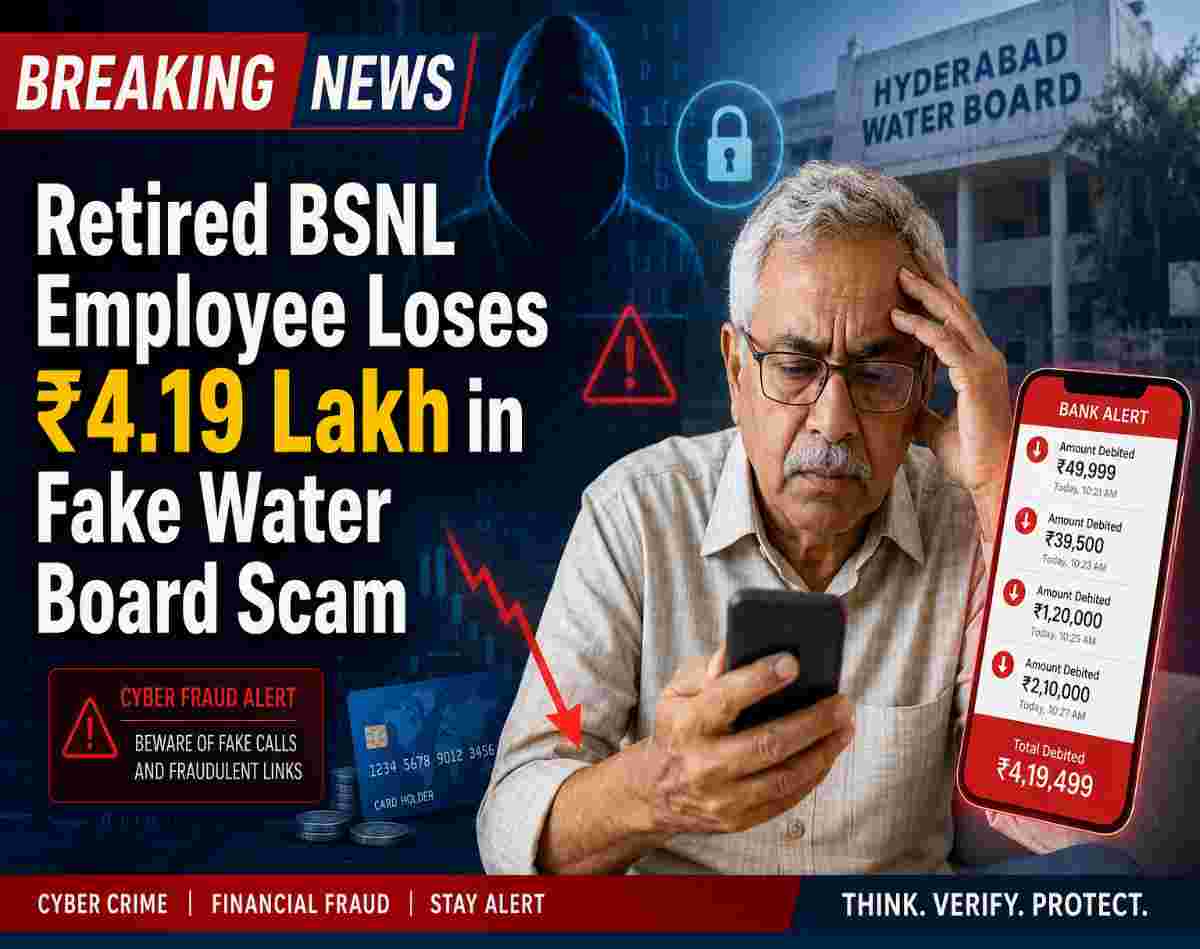
A retired BSNL employee allegedly lost ₹4.19 lakh after falling victim to a fake Hyderabad Water Board cyber fraud targeting unsuspecting citizens.
Retired BSNL Employee Loses ₹4.19 Lakh in Fake Hyderabad Water Board Scam
Unfortunately, cyber fraudsters are constantly finding new ways to deceive people, and senior citizens are increasingly becoming their primary targets. In a recent and deeply troubling incident in Hyderabad, a retired BSNL employee lost ₹4.19 lakh after falling victim to a fake Hyderabad Water Board scam. Posing as officials from the Hyderabad Metropolitan Water Supply and Sewerage Board (HMWSSB), the fraudsters convinced the victim to install a malicious application on his smartphone, which ultimately gave them complete access to his bank account.
This incident has once again highlighted the growing threat of online scams and the critical importance of staying alert while dealing with unknown phone calls, WhatsApp messages, and mobile applications. Furthermore, as cyber criminals become more sophisticated in their approach, understanding their modus operandi is the first step toward protecting oneself from financial fraud.
Victim: Retired BSNL employee, Hyderabad
Loss Amount: ₹4.19 Lakh
Fraud Type: Fake HMWSSB Water Board Scam via malicious APK
Platform Used: WhatsApp message with fraudulent APK file
How the Cyber Fraud Took Place
According to police officials, the victim received a WhatsApp message claiming to be from the Hyderabad Water Board. Specifically, it stated that there was an issue with his water connection and asked him to immediately update his personal details to avoid disruption of water services. To complete the verification process, the fraudsters instructed him to download and install a mobile application shared through WhatsApp as an APK file.
Unfortunately, believing the message to be genuine — it used official-sounding language and the logo of HMWSSB — the retired employee installed the application without realizing it was malicious software designed to steal sensitive information from his device.
Retired BSNL Employee Loses Claims Made by the Fraudsters
- First, water connection verification was pending and required immediate attention.
- Second, consumer account details needed to be updated urgently to continue service.
- Third, a small bill remained unpaid, and failure to pay would result in disconnection.
- Finally, water supply would be disconnected within 24 hours if action was not taken.
Notably, the victim was specifically instructed to install an APK file — an Android application package — instead of downloading any official app from the Google Play Store. Indeed, this is a major red flag that many victims unfortunately miss in the moment.
How the Malicious App Worked
Once installed, the malicious application silently obtained extensive permissions that allowed the fraudsters to monitor banking activities, intercept one-time passwords (OTPs), and even remotely control the victim’s smartphone. Using these unauthorized permissions, the cyber criminals successfully initiated and completed unauthorized transactions totaling ₹4.19 lakh from the victim’s bank account within a short span of time.
Retired BSNL Employee Loses Cyber Crime Police Register Case
After discovering the unauthorized transactions, the retired BSNL employee approached the Hyderabad Cyber Crime Police and lodged a formal complaint. Consequently, police have registered a case and initiated a thorough investigation to trace the individuals involved in this elaborate fraud.
As part of the investigation, officials are currently examining multiple pieces of digital evidence, including:
| Evidence Type | Purpose in Investigation |
|---|---|
| Mobile numbers used by scammers | Identify suspects and trace call patterns |
| Bank accounts receiving stolen funds | Freeze accounts and recover money |
| IP addresses and digital evidence | Locate geographic origin of fraud |
| WhatsApp communication records | Understand fraudster’s script and approach |
| Malicious APK file | Analyze technical capabilities of malware |
Additionally, cyber experts are analyzing the APK file used in the scam to understand its technical capabilities and to help develop better detection methods for similar threats in the future.
Why Senior Citizens Are Being Targeted
Sadly, cyber criminals often target retired employees and senior citizens because they may be less familiar with modern cyber threats, smartphone security practices, and common fraud patterns. Frauds like the Hyderabad Water Board scam, for instance, exploit trust by impersonating authoritative institutions.
Fraudsters commonly impersonate:
- Government departments and municipal authorities
- Electricity and power distribution boards
- Water supply and sewerage authorities
- Banks and financial institutions
- Telecom companies (including BSNL, Jio, Airtel, VI)
- Courier and delivery services
- Income Tax and GST departments
Many victims believe these messages are genuine because they appear urgent and use official-looking language, logos, and formatting. In fact, the scammers carefully craft their communication to mimic official notices, making it difficult for the average person to distinguish between legitimate and fraudulent messages.
Common Tricks Used by Cyber Criminals
The Hyderabad Water Board scam is just one of several methods currently being used by online fraudsters across India. For your awareness, below are some of the most prevalent scams to watch out for:
Fake Utility Bill Messages
In this scam, victims receive messages claiming their electricity, water, or gas connection will be disconnected unless immediate payment is made through a provided link.
Fake KYC Updates
Here, fraudsters pretend to be bank officials and ask customers to update KYC details through suspicious links that lead to phishing websites.
APK Installation Scam
Instead of directing victims to the Google Play Store, scammers send APK files through WhatsApp. Once installed, these apps can give hackers complete device access.
Remote Access Apps
With this method, victims are instructed to install screen-sharing or remote access applications like AnyDesk or TeamViewer, allowing criminals to operate the phone remotely.
Cyber Safety Tips: How to Protect Yourself
To stay safe, cyber experts advise all citizens to follow these essential precautions against scams like the Hyderabad Water Board fraud:
What to Do If You Become a Victim
If you suspect that you or someone you know has fallen victim to online fraud, time is of the essence. Fortunately, quick action can significantly improve the chances of freezing fraudulent transactions and recovering lost money. Here is what you should do:
- First, immediately contact your bank and request them to block your account or debit card to prevent further unauthorized transactions.
- Next, call the National Cyber Crime Helpline 1930 without any delay — this is a 24×7 toll-free number.
- Then, report the incident on the National Cyber Crime Reporting Portal (cybercrime.gov.in) for official documentation.
- After that, file a written complaint with the nearest Cyber Crime Police Station in your city.
- Finally, preserve all evidence including screenshots, SMS messages, call records, transaction details, and the fraudulent app name.
Retired BSNL Employee Loses Hyderabad Police Issue Public Advisory
Cyber Crime officials in Hyderabad have repeatedly warned citizens not to trust unsolicited WhatsApp messages claiming to represent government departments. In particular, authorities emphasize that official organizations do not ask customers to install APK files sent through messaging apps under any circumstances.
Instead, people are encouraged to independently verify any communication by contacting the concerned department through its official customer care number or website — never through the contact details provided in the suspicious message.
Growing Concern Over Cyber Frauds in India
India has witnessed a sharp increase in cyber fraud cases over the past few years. According to available data, thousands of citizens lose crores of rupees every month to various types of online scams. In reality, the actual figures may be significantly higher as many cases go unreported due to embarrassment or lack of awareness.
Moreover, scammers are continuously adopting new methods, including AI-generated voice calls that mimic the voice of family members or officials, fake customer care numbers appearing at the top of search results, sophisticated phishing websites that look identical to legitimate portals, and malicious mobile applications that can bypass security measures on smartphones.
Meanwhile, law enforcement agencies across India are strengthening their cyber investigation capabilities while simultaneously conducting awareness campaigns to educate citizens. However, public awareness remains the strongest defense against such crimes.
Conclusion
The case of the retired BSNL employee losing ₹4.19 lakh in a fake Hyderabad Water Board scam serves as a stark reminder that cyber criminals are becoming increasingly sophisticated in their methods. What makes these scams particularly dangerous is how believable they have become — using official logos, government department names, and urgent language to create a sense of panic that overrides rational judgment.
Installing unknown applications, clicking suspicious links, or responding to urgent messages without verification can lead to devastating financial losses that may wipe out a lifetime of savings. Indeed, this is especially tragic for senior citizens who depend on their retirement funds.
Therefore, citizens must remain cautious, verify every communication through official sources, and report suspicious activities immediately. Staying informed and practicing safe online habits are essential not just for protecting personal finances, but for contributing to a safer digital ecosystem for everyone. Furthermore, share this information with elderly family members, neighbors, and friends who may be vulnerable to such attacks. After all, a few minutes of awareness can prevent a lifetime of regret.
Frequently Asked Questions
The victim was a retired BSNL employee from Hyderabad who lost ₹4.19 lakh in an online fraud after being tricked by fraudsters posing as HMWSSB officials.
The scammers posed as Hyderabad Water Board officials and convinced the victim to install a malicious APK application via WhatsApp. Subsequently, the app enabled unauthorized access to his banking information and OTPs.
In total, the victim lost ₹4.19 lakh through multiple unauthorized bank transactions carried out remotely by the cyber criminals.
First, do not install unknown applications or click suspicious links. Instead, verify the message by contacting the official department directly. Finally, report suspicious activity to the Cyber Crime Helpline at 1930 and file a report on cybercrime.gov.in.
The National Cyber Crime Helpline number is 1930. It is a toll-free, 24×7 helpline for reporting cyber crimes and online financial frauds in India. Whenever you suspect fraud, you should call this number immediately.
About the Author