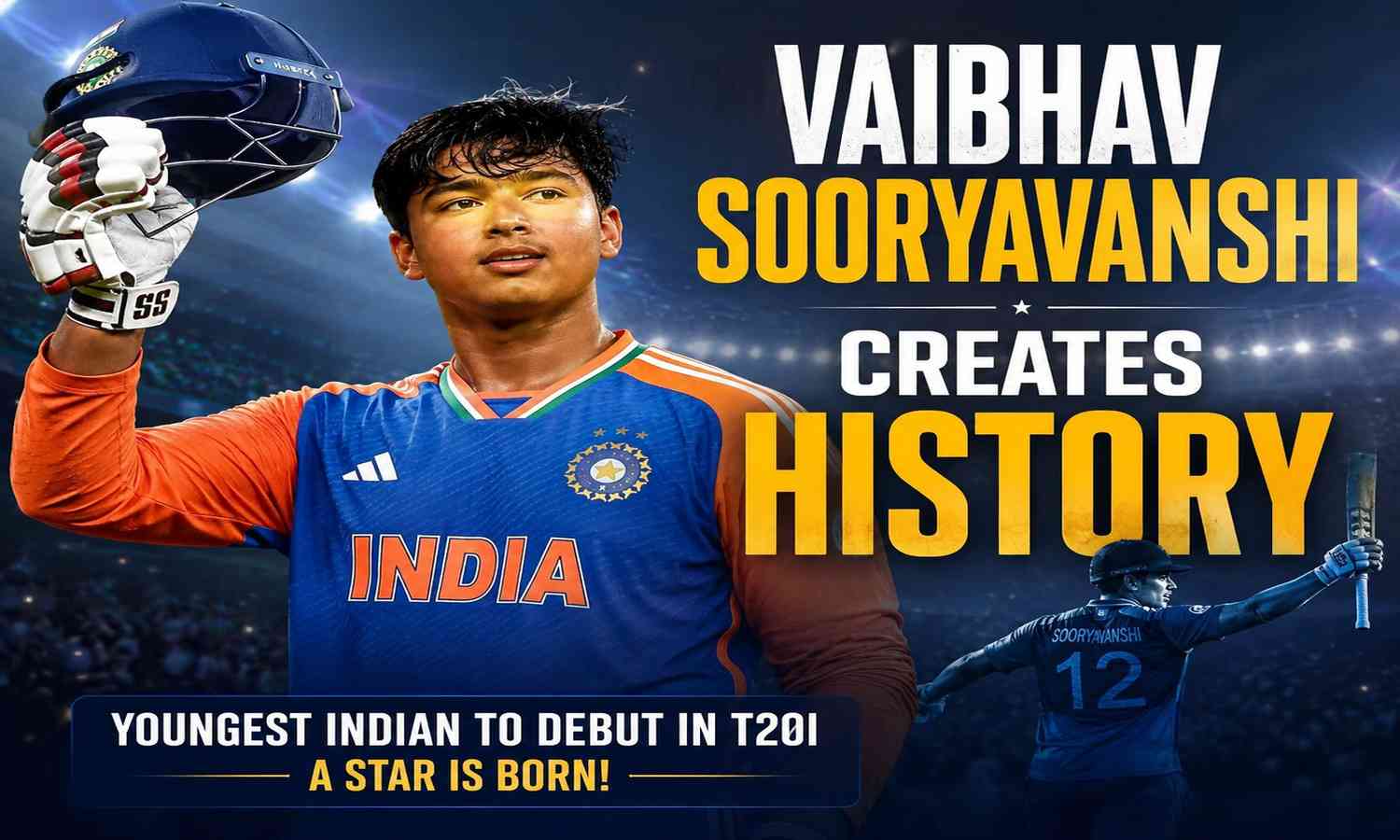
Vaibhav Sooryavanshi Creates History: Becomes Youngest Indian to Play International Cricket at 15
The Bihar prodigy breaks Sachin Tendulkar’s 36-year-old record on debut against England at Old Trafford
On a historic day at Old Trafford in Manchester on July 4, 2026, India took on England in the second T20I of the five-match series. A 15-year-old boy from Tajpur, Bihar, walked onto the field wearing the iconic blue jersey for the very first time. With that walk, Vaibhav Sooryavanshi shattered a record that had stood for nearly four decades — becoming the youngest ever Indian cricketer to make an international debut, surpassing the legendary Sachin Tendulkar.
At 15 years, 3 months and 7 days (15 years, 99 days), Sooryavanshi eclipsed Tendulkar’s long-standing record of 16 years and 205 days, set all the way back in 1989. Indeed, this moment was the culmination of a fairy-tale rise that has seen the teenager go from playing in the bylanes of Samastipur to becoming the most talked-about cricketer on the planet in less than three years.
Vaibhav Sooryavanshi Creates History on His Record-Breaking Debut
After winning the toss, India elected to bat first under overcast and windy conditions at Old Trafford. Notably, captain Shreyas Iyer had no hesitation in handing the debut cap to Sooryavanshi, who opened the batting alongside the explosive Abhishek Sharma. Earlier, the youngster received his maiden India cap from Tilak Varma in a heartwarming ceremony, with head coach Gautam Gambhir offering an inspiring speech before the team took the field.
Finally, the moment everyone had been waiting for arrived in the very first over. Facing the raw pace of Jofra Archer — one of the fastest bowlers in world cricket — Sooryavanshi did what he has done throughout his young career: he attacked. Specifically, Archer dug one in short, trying to cramp the left-hander for room. However, the 15-year-old produced a jaw-dropping no-look whip-scoop behind square for six instead. Remarkably, his first ball in international cricket, and he had already cleared the ropes.
“I didn’t think too much. I just wanted to make the most of the first 10 overs and execute my plans. There was no pressure.” — Vaibhav Sooryavanshi after his debut innings
He quickly followed it up with another maximum off Josh Tongue, a more familiar IPL-style hoick over long-on that sent the Indian contingent in the stands into a frenzy. However, his stay was brief. Soon after, England captain Harry Brook introduced off-spinner Will Jacks, and Sooryavanshi, attempting to charge down the track, missed a wide loopy delivery by a considerable distance. Consequently, wicketkeeper Jos Buttler did the rest, dislodging the bails in a flash. Ultimately, Sooryavanshi was dismissed for 14 off 10 balls, with two sixes and a couple of singles to his name.
While it was not the blockbuster knock many had hoped for, the 15-year-old showed glimpses of the audacious talent that has taken the cricketing world by storm. Nevertheless, his brief innings offered enough evidence that the hype was justified.
Vaibhav Sooryavanshi Creates History in India’s Innings of Patches and Promise
Overall, India’s total of 190 for 7 in 20 overs was built on a series of promising but incomplete contributions. Initially, Abhishek Sharma looked in discomfort early on, playing and missing at Archer’s express pace on multiple occasions. In fact, he played and missed around 10 of his first 12 deliveries. However, once the pace softened, he found his rhythm, smashing 43 off just 24 balls with 8 fours and a six. Unfortunately, his innings ended in misfortune — a sharp flick off a Sam Curran full toss went straight to Tom Banton, who was stationed well inside the midwicket boundary.
Meanwhile, skipper Shreyas Iyer played a responsible knock of 37 off 22 balls, using his feet well against the spinners. Nevertheless, he found boundary-scoring difficult on the expansive Old Trafford ground. He later added 65 runs for the third wicket with Ishan Kishan, stabilising the innings after early wickets.
Ishan Kishan was the top-scorer with 49 off 40 balls, but it was far from his cleanest innings. Specifically, the wicketkeeper-batter struggled to pick the slower deliveries and variations in length, looking exceptionally scratchy through the middle overs. As a result, he managed just 6 fours and no sixes in his 40-ball stay — a testament to how well England’s bowlers adapted to the conditions.
India Innings Scorecard
| India Innings Scorecard | ||||||
|---|---|---|---|---|---|---|
| Batter | R | B | 4s | 6s | SR | Dismissal |
| Abhishek Sharma | 43 | 24 | 8 | 1 | 179.17 | c Banton b Curran |
| Vaibhav Sooryavanshi | 14 | 10 | 0 | 2 | 140.00 | st Buttler b Jacks |
| Ishan Kishan (wk) | 49 | 40 | 6 | 0 | 122.50 | c Dawson b Curran |
| Shreyas Iyer (c) | 37 | 22 | 3 | 1 | 168.18 | c Banton b Dawson |
| Shivam Dube | 5 | 7 | 0 | 0 | 71.43 | c Banton b Curran |
| Tilak Varma | 24* | 11 | 1 | 2 | 218.18 | not out |
| Axar Patel | 2 | 3 | 0 | 0 | 66.67 | run out (Buttler) |
| Harshit Rana | 6 | 3 | 0 | 1 | 200.00 | c Buttler b Archer |
| Total: 190/7 (20 Overs, RR: 9.50) | ||||||
Late Fireworks from Tilak Varma
In the lower order, Axar Patel fell cheaply for 2, run out by a sharp piece of work from Jos Buttler. However, the real fireworks came in the final over. Specifically, Tilak Varma, whose batting approach has been heavily criticised in recent months, produced a stunning cameo. He smashed Jofra Archer for 17 runs in the 20th over, remaining unbeaten on 24 off just 11 balls with 1 four and 2 sixes. Additionally, Harshit Rana chipped in with a quick 6 off 3 balls before holing out to Buttler off Archer on the final delivery.
For England, Sam Curran was the pick of the bowlers with 3 for 33 in 4 overs, using his pace-off strategy and slower variations to great effect. Similarly, Will Jacks (1/22), Liam Dawson (1/27) and Adil Rashid (0/21) all bowled economically, making life difficult for the Indian batters in the middle overs.
England’s Bowling Response
England’s Chase: The Jacob Bethell Show
In response, chasing 191, England’s reply got off to a disastrous start. Firstly, Arshdeep Singh, India’s premier death bowler, produced a brilliant first over, dismissing both openers — Philip Salt for a golden duck and Jos Buttler for 0 — to leave England reeling at 2 for 2. Consequently, the Old Trafford crowd was stunned into silence.
But what followed was a masterclass in counter-attacking cricket. Specifically, captain Harry Brook took the attack to the Indian bowlers, smashing 39 off just 15 balls with 4 fours and 3 sixes. He added 50 runs with Jacob Bethell before Axar Patel struck, with Ishan Kishan taking a sharp catch behind the stumps to dismiss Brook.
Bethell and Banton Steady the Ship
Subsequently, Tom Banton joined Bethell, and the pair added a crucial 50-run partnership for the fourth wicket. Banton played the anchor role to perfection, scoring 39 off 32 balls with 6 fours, rotating the strike and keeping the scoreboard ticking. However, it was Jacob Bethell who stole the show.
Throughout his innings, Bethell was simply sensational. The left-hander played with a maturity that belied his years, mixing calculated aggression with smart placement. He brought up his fifty off 33 balls and continued to accelerate, finishing unbeaten on 76 off just 46 deliveries — an innings adorned with 5 fours and 5 sixes. In between, Will Jacks fell cheaply to Varun Chakaravarthy, and Sam Curran made a brisk 7 before falling to Harshit Rana. Despite these setbacks, Bethell held firm at one end.
Nearing the finish line with 17 needed off the last two overs, Jofra Archer walked in and smashed a quick 10 off 7 balls to seal the victory. Consequently, England reached the target with one over to spare, winning by 4 wickets. Ultimately, Jacob Bethell was deservedly named Player of the Match for his match-winning knock.
From Samastipur to Old Trafford: The Vaibhav Sooryavanshi Story
For those who have followed Vaibhav Sooryavanshi’s journey, his international debut was never a question of “if” but “when.” Born on March 27, 2011, in Tajpur, Samastipur, Bihar, Sooryavanshi has been breaking records since he was a child. Specifically, his first-class debut for Bihar against Mumbai came at just 12 years old — one of the youngest first-class cricketers in Indian history. By 13, he had already become the youngest player ever to sign an IPL contract when Rajasthan Royals picked him up for ₹1.1 crore. At 14, he scored 101 off 38 balls against Gujarat Titans in the IPL, becoming the youngest centurion in IPL history. Then at 15, he amassed 776 runs in IPL 2026 at a jaw-dropping strike rate of 237.30, winning the Orange Cap and smashing Chris Gayle’s record for most sixes in a single IPL season.
To put it in perspective, his IPL numbers alone are staggering: 72 sixes in a single season (breaking Gayle’s record of 59), 521 runs in the powerplay (the most by any batter in IPL history in the first six overs), and five individual awards in one season — Orange Cap, Most Valuable Player, Emerging Player, Super Striker, and Super Sixes — something no player has ever achieved before.
Under-19 World Cup Heroics
Furthermore, his Under-19 exploits were equally remarkable. In the 2026 ICC Under-19 World Cup final against England, he scored 175 off 80 balls — the highest individual score in a U19 World Cup final — and was named Player of the Tournament. Additionally, he scored the fastest half-century in List A history, reaching the mark in just 11 balls while playing for India A in Sri Lanka.
Vaibhav Sooryavanshi Creates History: What This Means for Indian Cricket
Beyond the records, Vaibhav Sooryavanshi’s debut signifies a major shift in Indian cricket. Specifically, the BCCI and the team management, led by head coach Gautam Gambhir, have shown a willingness to invest in youth like never before. In a country where cricketers traditionally debuted in their early 20s, the sight of a 15-year-old walking out to face Jofra Archer at Old Trafford represents a paradigm shift.
Former India captain Sunil Gavaskar said on commentary, “We are witnessing something very special. The last time we saw a teenager debut with this much anticipation was Sachin Tendulkar in 1989. Vaibhav has the game, the temperament, and most importantly, the hunger. This is just the beginning.”
Sachin Tendulkar himself had earlier remarked, “Everyone is talking about Sooryavanshi, and I watched him bat. It was magnificent. He is something truly special.”
Match Summary
| Match Details | ||||||
|---|---|---|---|---|---|---|
| Match: 2nd T20I, India tour of England 2026 | ||||||
| Venue: Old Trafford, Manchester | ||||||
| Toss: India won, elected to bat | ||||||
| Result: England won by 4 wickets | ||||||
| Player of the Match: Jacob Bethell (76* off 46) | ||||||
| T20I Debuts: Vaibhav Sooryavanshi (Ind), Josh Tongue (Eng) | ||||||
| Record: Vaibhav Sooryavanshi became India’s youngest men’s international debutant (15y 99d), surpassing Sachin Tendulkar (16y 205d) | ||||||
Series Context and What’s Next
Looking ahead, the first T20I of the series at Chester-le-Street was abandoned due to rain after India posted 189/7 in 20 overs. With the second T20I resulting in an England win, the hosts now lead the five-match series 1-0. Notably, the third T20I is scheduled for July 7 at Trent Bridge, Nottingham, where India will look to level the series.
For Vaibhav Sooryavanshi, the journey has only just begun. At 15, he has the world at his feet. Indeed, if his debut innings was any indication — a first-ball six off one of the fastest bowlers in the world — the cricketing world should buckle up for what promises to be an extraordinary ride.
As the boy from Bihar walked off the Old Trafford pitch, the crowd rose to their feet. They had not just witnessed a cricketer; instead, they had witnessed the birth of a phenomenon. Clearly, Vaibhav Sooryavanshi is here, and he is just getting started.
PM Modi New Zealand Visit: Strengthening Bilateral Ties
Telangana Bonalu Festival 2026: Celebrations and Traditions
Follow the India tour of England 2026 for more updates on Vaibhav Sooryavanshi and the rest of the series.
About the Author






1 thought on “Vaibhav Sooryavanshi Creates History”