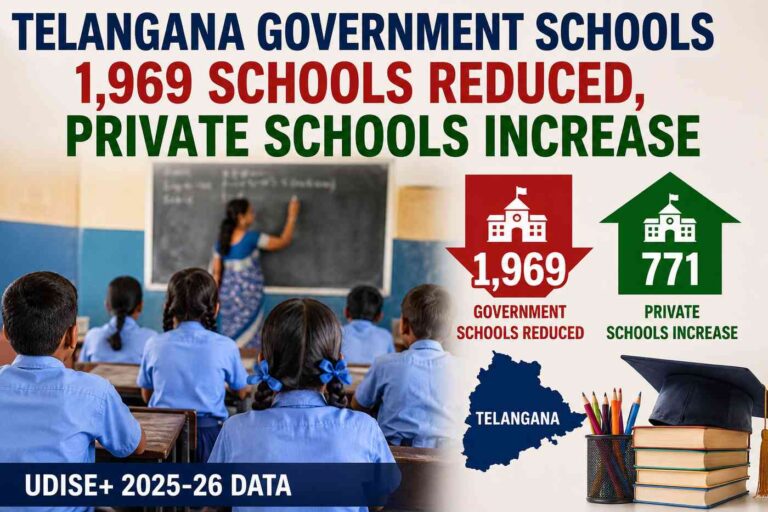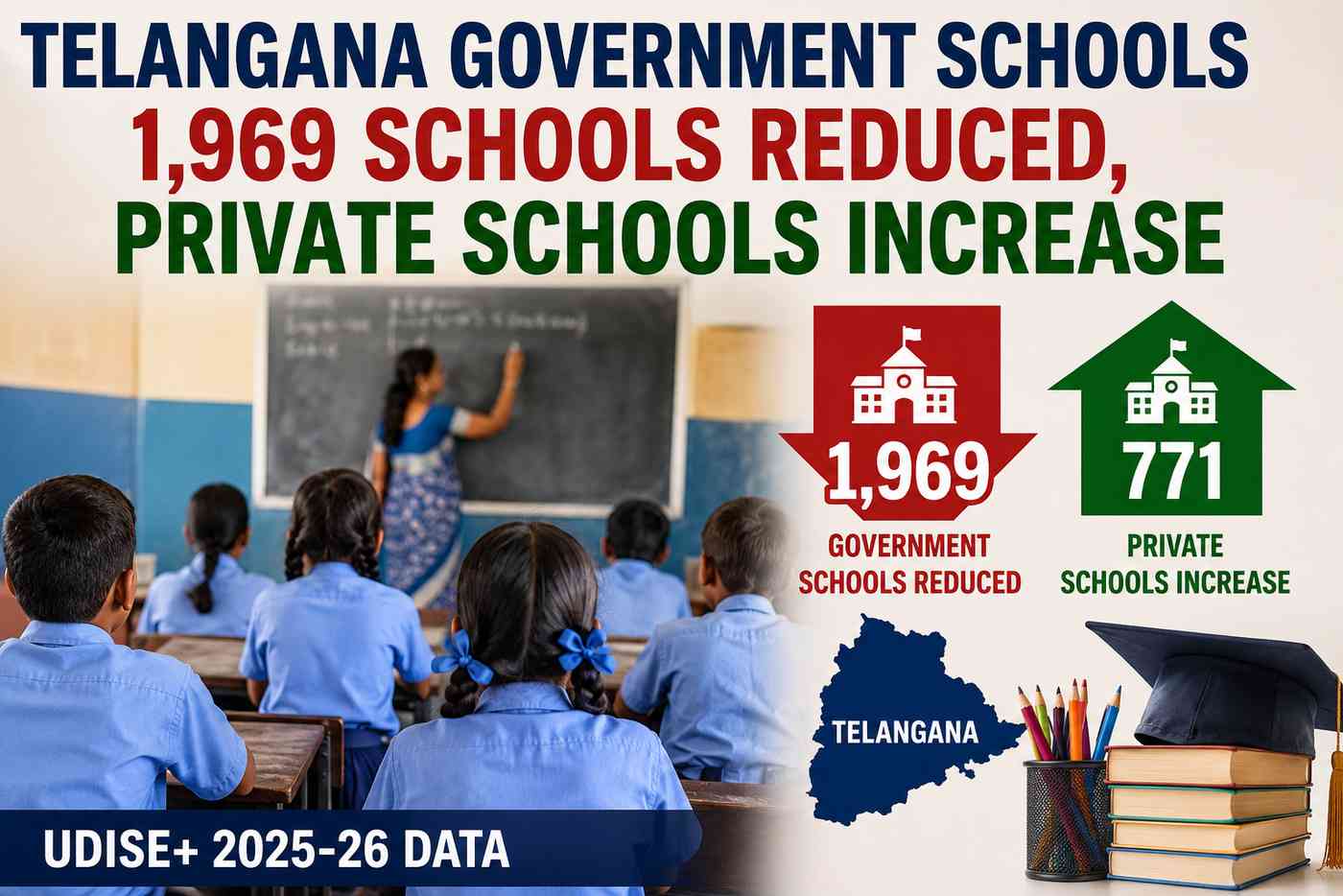
Telangana government schools declined by 1,969, while private schools increased by 771 in 2025-26.
Telangana Government Schools Decline by 1,969 in 2025-26: Private Schools Rise by 771
The Telangana education landscape is undergoing one of its most significant shifts in recent years. According to the latest Unified District Information System for Education Plus (UDISE+) data for the 2025-26 academic year, the number of Telangana Government Schools has declined by 1,969, while private schools have registered an increase of 771. These contrasting trends have reopened important discussions about where students are studying, why families are making new school choices, and how the state should plan its public education infrastructure for the coming decade.
Government schools have always been the backbone of affordable education in Telangana, especially for children from rural areas, tribal belts and economically weaker families. When official numbers show a sharp reduction in public institutions and steady growth in private ones, it is essential to look beyond the headlines. This article examines the UDISE+ 2025-26 data, the reasons behind the shift, its impact on rural students, and the measures that can strengthen the state’s public education system.
Telangana Government Schools Decline in 2025-26
The latest UDISE+ figures point to a considerable reduction in the number of Telangana Government Schools during the 2025-26 academic year compared with the previous one. Reports indicate that the state recorded 1,969 fewer government schools in the official database. In the same period, private schools grew by approximately 771, creating a clear divergence between the two segments of the school system.
It is important to understand, however, that a reduction in the official count does not automatically mean that all 1,969 schools were physically shut down. School numbers in government databases can change for several reasons, including consolidation of small schools, administrative restructuring, mergers with neighbouring institutions, extremely low enrolment, and changes in school recognition or classification. This means the figures serve as an important indicator of the changing structure of school education in Telangana, but individual school-level closures must be verified and examined separately.
- 1,969 fewer Telangana Government Schools in UDISE+ 2025-26 data
- 771 additional private schools recorded in the same period
- Reduction may reflect mergers, consolidation and reclassification, not just physical closures
- The data signals a broader structural shift in the state’s education system
Private Schools Increase in Telangana
While the number of government schools declined, private schools recorded visible growth. According to reports based on UDISE+ data, private schools increased by 771 in Telangana in 2025-26. This expansion is part of a longer-term trend, with more families across the state choosing private institutions for their children’s education every year.
Several factors influence this choice. Parents often prioritise English-medium instruction, classroom infrastructure, transportation facilities, digital learning resources, academic programmes and extracurricular activities when selecting a school. Private schools are also expanding rapidly in urban and semi-urban areas, where demand for diverse educational services is high and the presence of multiple institutions makes comparison easier for families.
At the same time, the growth of private schools should not be read as proof that every private institution offers better education than a government school. Educational quality varies significantly from one school to another, and both government and private schools can be found with excellent as well as poor outcomes. The key point is that the mix of schools is changing, and that change deserves closer attention.
Telangana Government Schools Decline Enrolment Also Changes
School counts tell only half the story. Student enrolment is an equally important measure of how the education system is evolving. Long-term UDISE+ data indicates that government school enrolment in Telangana has been declining steadily, while private school enrolment has grown sharply.
Reports suggest that between 2016-17 and 2025-26, government school enrolment declined by around 8.2%, whereas private school enrolment increased by approximately 41%. This shift suggests that the preference of many families has gradually moved towards private education over the past decade.
| Indicator (2016-17 to 2025-26) | Government Schools | Private Schools |
|---|---|---|
| Change in Number of Schools (2025-26) | -1,969 | +771 |
| Change in Enrolment | -8.2% | +41% |
| Enrolment Base | Largest in rural areas | Growing in urban/semi-urban |
| Cost to Families | Free / nominal fees | High recurring fees |
However, enrolment numbers are influenced by many factors beyond school preference. Population changes, migration, urbanisation, the availability of schools in a locality, parental expectations and the expansion of private institutions all play a role. For a complete picture, enrolment data must be examined alongside demographic trends and district-level patterns.
Why Are Parents Choosing Private Schools?
Understanding the reasons behind the shift is critical for policymakers who want to strengthen public education. Several recurring themes explain why many parents now prefer private institutions.
Demand for English-Medium Education
English-medium education has become an important consideration for many families. Parents often believe that stronger English language skills will help their children in higher education, competitive examinations and future employment. Private schools frequently promote English-medium instruction as one of their major advantages, which influences the decision-making process.
Government schools have also introduced English-medium sections in various areas, but perceptions about the quality of language teaching and the methods used continue to shape parental choices. Bridging this perception gap is one of the biggest challenges facing the public school system.
Better Infrastructure
Infrastructure is another deciding factor. Parents compare classrooms, laboratories, libraries, computer facilities, playgrounds, toilets, drinking water and digital learning resources before choosing a school. Some government schools have received substantial infrastructure improvements, but facilities can vary considerably between districts and even between individual schools.
Consistently improving infrastructure across Telangana Government Schools, particularly in rural and semi-urban areas, could help restore parental confidence in public education and slow the drift towards private institutions.
Teacher Availability
Teachers are the most important component of any school. A school needs sufficient teachers to manage different classes and subjects effectively. Shortages or uneven teacher distribution can create serious difficulties for both students and staff. Reports have repeatedly highlighted teacher vacancies and postings that do not match student numbers in several parts of Telangana.
Aligning teacher deployment with enrolment patterns, improving training and equipping teachers with modern teaching resources can contribute directly to better learning outcomes and a stronger reputation for government schools.
Telangana Government Schools Decline Impact on Rural Students
The decline in Telangana Government Schools can have a deeper impact on rural and remote communities than on urban ones. In cities, students often have several schools within a short distance. If one school is consolidated or closed, parents may simply choose another nearby institution.
In villages and remote areas, however, a government school is frequently the only affordable educational option within reach. If schools are merged, relocated or closed, children may be forced to travel longer distances every day. This creates additional difficulties for young children and for families without reliable transport, and in some cases may push children out of school altogether.
Government Schools Remain Essential for Affordable Education
Despite the challenges, government schools continue to play an essential role in ensuring access to education. For many families, they provide schooling without the high fees charged by private institutions, and they remain the primary option for students from economically weaker backgrounds. Government schools also perform an important social function beyond classrooms, providing mid-day meals, uniforms, learning material and a safe daily environment for lakhs of children.
Improving the quality of Telangana Government Schools can ensure that students receive a good education without placing additional financial pressure on their families. A strong public school network is the foundation of inclusive, equitable education in the state.
Need to Improve Telangana Government Schools
The latest figures highlight the need to strengthen the public education system. Improvement should focus on multiple areas rather than simply increasing the number of schools. Quality, accessibility and outcomes matter far more than numbers alone.
Modern Classrooms
Schools need safe, clean and well-maintained classrooms that create a positive learning environment. Repairing dilapidated buildings, ensuring adequate ventilation and keeping facilities clean are basic requirements that influence both attendance and learning.
Digital Learning
Technology can support students through digital lessons, educational videos, online resources and interactive learning tools. Providing reliable internet connectivity and digital equipment can help government schools adapt to modern education requirements and compete with the facilities offered by private schools.
Libraries and Laboratories
Libraries encourage reading habits, while science laboratories provide hands-on practical learning. These facilities make government schools more attractive to students and parents and directly improve academic preparation.
Better Sanitation
Clean toilets, safe drinking water and proper sanitation facilities are essential for students, especially girls. Schools must regularly maintain these facilities to ensure a safe and healthy environment.
Sports Facilities
Education should not focus only on academics. Playgrounds and sports facilities support children’s physical development, teamwork and confidence, and give students additional reasons to enjoy school.
- Improving classroom infrastructure and school buildings
- Ensuring adequate, well-distributed teachers
- Strengthening English-language teaching
- Expanding digital education and internet access
- Improving sanitation, drinking water and hygiene
- Providing better sports and playground facilities
- Strengthening libraries and science laboratories
- Increasing parent participation and communication
- Monitoring attendance and providing academic support
Role of UDISE+ Data
The Unified District Information System for Education Plus, commonly known as UDISE+, is one of India’s major school education data systems. It collects information related to schools, students, teachers, infrastructure and other education indicators across the country. Governments at both state and national level use this data to understand the condition of the school education system and to plan policies.
The UDISE+ 2025-26 data has therefore become an important reference for understanding recent changes in Telangana’s education sector. However, individual numbers should always be interpreted in context. A reduction in the number of schools does not necessarily mean that the same number of schools were permanently closed. Administrative restructuring, school mergers and changes in recognition can all affect official school counts, so the data must be read carefully before drawing conclusions.
Government and Private Schools Can Coexist
The growth of private schools should not be viewed as a competition that government schools must eliminate. Both government and private schools contribute to the education system, and both have strengths and weaknesses. The objective should be to ensure that every child has access to quality education regardless of family income or location.
A strong government school network provides an essential foundation for inclusive education, while private schools offer additional choices for families. The policy focus should therefore remain on educational quality, accessibility and student outcomes rather than on institutional rivalry.
Frequently Asked Questions (FAQ)
How many Telangana Government Schools were reduced in 2025-26?
According to UDISE+ 2025-26 data, the number of Telangana Government Schools declined by 1,969 compared with the previous year. The reduction includes schools merged, consolidated or reclassified, and does not automatically mean all 1,969 schools were physically closed.
How many private schools increased in Telangana in 2025-26?
Private schools in Telangana increased by around 771 in 2025-26, according to reports based on UDISE+ data, continuing a long-term trend of growth in the private school sector.
What is the enrolment trend for government and private schools in Telangana?
Between 2016-17 and 2025-26, government school enrolment in Telangana declined by about 8.2%, while private school enrolment increased by approximately 41%, according to long-term UDISE+ data.
Why are parents choosing private schools over Telangana Government Schools?
Parents often choose private schools for English-medium education, better infrastructure, transportation, digital learning facilities, extracurricular activities and perceived academic quality. Rural and economically weaker families, however, continue to depend heavily on government schools.
Does a reduction in school numbers mean schools were permanently closed?
Not necessarily. Official school counts can change due to school consolidation, mergers, administrative restructuring, low enrolment and changes in recognition or classification. School-level closures need to be examined separately.
Conclusion
The decline of 1,969 Telangana Government Schools and the increase of 771 private schools reported for 2025-26 highlight a significant change in the state’s education landscape. The trend is also visible in enrolment patterns, with government school enrolment declining over the longer term while private school enrolment has grown substantially.
Yet the figures must be interpreted with care. A reduction in official school numbers does not necessarily mean that every school was permanently closed. School mergers, consolidation, administrative changes and enrolment patterns can all influence the data. The latest developments nevertheless underline the importance of strengthening Telangana Government Schools through better infrastructure, adequate teachers, digital learning facilities, improved academic outcomes and stronger community participation.
Government schools remain essential for providing affordable and accessible education to thousands of children across Telangana, especially in rural areas. Improving their quality, adapting them to changing educational expectations and communicating those improvements to parents can help restore confidence in public education. If that is done effectively, government and private schools can together ensure that every child in Telangana receives a fair chance at a better future.
About the Author