
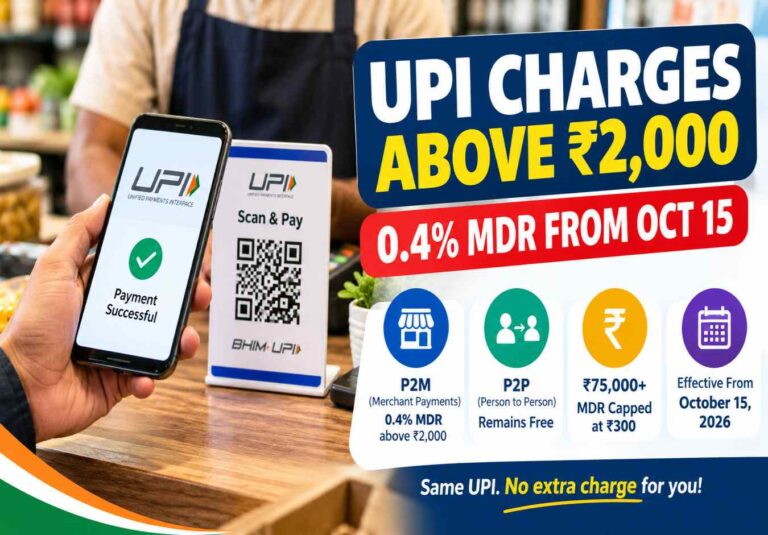
UPI New Rule 2026: The government may allow MDR on merchant UPI payments above ₹2,000. No final decision has been announced yet.
UPI New Rule 2026: Charges on Payments Above ₹2,000? Latest Government Update Explained
The UPI new rule 2026 debate is centred on the Merchant Discount Rate (MDR) proposal for high-value merchant payments above ₹2,000. Will UPI remain free for ordinary users? Here is everything about the new UPI rules 2026, their impact on consumers, merchants and small businesses.

India’s Unified Payments Interface (UPI) has completely transformed the way people make digital payments. From purchasing groceries and paying electricity bills to booking train tickets and shopping online, UPI has become the preferred payment method for millions of Indians because it is fast, secure, and free. However, recent reports about a possible UPI new rule 2026 that could allow UPI Charges on Payments Above ₹2,000 have created widespread discussion among consumers, merchants, banks, and fintech companies.
The proposal has raised several important questions. First, will UPI remain free for ordinary users? Second, will customers have to pay extra when making payments at shops? Third, what is the Merchant Discount Rate (MDR), and why is the government considering bringing it back? Answering these questions matters because UPI has become a key pillar of India’s digital economy. In this article, we explain the latest developments, why the proposal has emerged, its possible impact on users and businesses, and what could happen next if the policy is implemented.
UPI New Rule 2026: What Is the Latest Proposal on UPI Charges?
According to recent reports, the Central Government has introduced amendments to the Payment and Settlement Systems Act, creating a legal framework that would allow the government to impose a Merchant Discount Rate (MDR) on selected digital payment transactions, including UPI, in the future.
It is important to note that the government has not announced any immediate UPI transaction charges. Instead, the proposed amendment gives authorities the power to introduce such charges later if they consider them necessary after consulting stakeholders. At present, the discussions focus on merchant transactions above ₹2,000, while person-to-person (P2P) transfers will likely remain free. If implemented, moreover, the proposal would mainly affect payments made to businesses rather than transfers between family members or friends.
The government has not implemented any UPI charges yet. It is only creating a legal framework that could allow a Merchant Discount Rate (MDR) on certain high-value merchant transactions in the future, subject to stakeholder consultation.
What Is Merchant Discount Rate (MDR)?
Merchant Discount Rate, commonly known as MDR, is a small fee that merchants pay whenever they receive digital payments through payment networks. Typically, MDR helps cover the operational costs that banks, payment service providers, card networks, and UPI payment platforms incur.
Before January 2020, merchants paid MDR even for UPI and RuPay card transactions. However, to encourage digital payments across India, the government removed these charges, allowing merchants to accept UPI payments without paying transaction fees. As a result, the zero-MDR policy played a significant role in increasing UPI adoption among small businesses, local vendors, and consumers.
Why Is the Government Considering MDR in the UPI New Rule 2026?
Several factors have contributed to the renewed discussion around merchant charges under the proposed UPI new rule 2026. Since the zero-MDR policy began in 2020, UPI has grown extraordinarily, and the platform now processes billions of transactions every month. While customers enjoy free payments, banks, gateways, and fintech companies still invest heavily in infrastructure — from secure processing and banking systems to cybersecurity, fraud detection, and customer support.
Many financial institutions doubt that a completely free payment ecosystem can remain sustainable indefinitely. Consequently, discussions have turned to introducing MDR for selected merchant transactions, especially those involving higher payment amounts. The main reasons behind the proposal include:
1. Growing Digital Payment Volume
India processes billions of UPI transactions every month. As transaction volumes continue to rise, the cost of maintaining payment infrastructure also increases.
2. Financial Sustainability
Banks and payment service providers argue that the current zero-MDR system limits their ability to recover operational expenses while continuing to invest in technology and security.
3. Better Payment Infrastructure
Additional revenue could help payment companies invest in faster processing, advanced fraud prevention, stronger cybersecurity, better customer service, and new digital payment innovations.
4. Reducing Government Financial Support
At present, the government provides incentives to banks and payment companies to compensate for the absence of MDR. Allowing merchant charges on selected transactions could reduce the government’s financial burden while maintaining support for digital payments.
Why Is the ₹2,000 Limit Important?
The figure of ₹2,000 has emerged in discussions because policymakers aim to protect everyday consumers while considering the financial sustainability of the payment ecosystem. In particular, if charges apply only to merchant payments above ₹2,000:
- Daily purchases such as groceries, medicines, and food may remain unaffected.
- Small merchants may continue to enjoy free digital payment acceptance.
- Higher-value commercial transactions could contribute to payment infrastructure costs.
However, the government has not officially confirmed the final transaction limit or any MDR percentage. Therefore, these details will depend on future policy decisions.
UPI New Rule 2026: Will Ordinary UPI Users Have to Pay?
One of the biggest concerns among consumers is whether every UPI transaction will become chargeable under the new rule. Based on current discussions, the answer appears to be no. Personal transfers between individuals will likely remain free. Furthermore, the proposal mainly concerns merchant payments, where businesses receive money from customers through UPI. For example:
- Sending money to parents – Expected to remain free.
- Paying friends – Expected to remain free.
- Splitting restaurant bills with friends – Expected to remain free.
- Paying a retail store for a purchase above ₹2,000 – Merchant charges may apply if the proposal is approved.
This distinction is important because most everyday users primarily use UPI for personal transfers and low-value purchases.
| Transaction Type | Expected Status |
|---|---|
| P2P transfer to family or friends | Remains free |
| Bill splitting with friends | Remains free |
| Merchant payment below ₹2,000 | Remains free |
| Merchant payment above ₹2,000 | MDR may apply (proposal stage) |
How Could the New Rule Affect Businesses?
If the government eventually introduces a Merchant Discount Rate (MDR) on UPI Charges on Payments Above ₹2,000, businesses that regularly receive high-value UPI payments could see an increase in transaction costs. Although the government has not yet announced the final policy, many merchants are already evaluating how such a change could affect their operations.
Retail Stores
Retail outlets selling electronics, furniture, jewellery, home appliances, and other high-value products often receive payments above ₹2,000. If MDR is introduced, these businesses may have to absorb the additional transaction cost or adjust their pricing strategies.
Restaurants and Hotels
Restaurants, cafés, hotels, and hospitality businesses frequently receive bills above ₹2,000, especially for family dining or group bookings. Depending on the final policy, these establishments could experience additional payment processing expenses.
Hospitals and Healthcare Providers
Hospitals, diagnostic centres, and private clinics often process payments much higher than ₹2,000. If merchant charges are introduced, healthcare providers may also need to consider the impact on their digital payment systems.
E-commerce Platforms
Online shopping websites receive thousands of UPI payments every day. An MDR policy could influence payment costs for online retailers, although many large businesses already account for payment processing expenses in their financial planning.
Impact on Small Businesses
One of the biggest questions surrounding the proposal is how it could affect small traders and local shops. Fortunately, many experts believe the government will try to protect small businesses because they have played a significant role in India’s digital payment success. Small grocery stores, vegetable vendors, street food sellers, and neighbourhood shops adopted UPI rapidly because accepting payments involved little or no additional cost.
If MDR is limited only to higher-value merchant transactions, most small businesses may experience minimal impact since many of their daily transactions are below ₹2,000.
Benefits of Introducing MDR
Supporters of the proposal, on the other hand, argue that introducing MDR on selected transactions could strengthen India’s digital payments ecosystem over the long term.
Sustainable Payment Infrastructure
Banks and payment service providers spend significant amounts on maintaining servers, cybersecurity, software upgrades, fraud monitoring, and customer support. MDR could provide a stable revenue source to support these services.
Improved Security
Additional investment may allow payment companies to strengthen fraud detection systems, improve cybersecurity measures, and reduce financial cybercrime.
Better Customer Experience
Revenue generated from merchant charges could help companies improve faster transaction processing, reduced payment failures, better dispute resolution, enhanced customer support, and new digital payment features.
Encouraging Innovation
Financial institutions may invest more in advanced technologies such as artificial intelligence, real-time fraud detection, biometric authentication, and next-generation digital payment solutions.
What Concerns Do Merchants Have?
However, not everyone supports the proposal. Several business associations have expressed concerns that introducing MDR may increase operational costs, particularly for businesses with high transaction volumes. Some of the key concerns include:
- Higher business expenses
- Reduced profit margins
- Possible increase in product prices
- Lower preference for digital payments
- Additional accounting and compliance requirements
Many merchant organisations believe the zero-MDR policy has driven India’s digital payment growth, and they caution against making changes that could discourage digital transactions.
India has built one of the world’s largest real-time payment networks by keeping UPI simple, secure, and free. Any change to this model should be carefully implemented so that consumer confidence remains strong.
Fintech industry viewpoint
Banks, Fintech & Expert Reactions
Industry experts remain divided on the UPI new rule 2026 and the proposed UPI Charges on Payments Above ₹2,000.
Why Banks Support the Proposal
Many banks argue that maintaining UPI infrastructure involves significant operational costs — every digital transaction requires secure servers, fraud detection systems, customer support, software maintenance, and compliance with financial regulations. In addition, banks believe that a limited MDR on higher-value merchant transactions could help them recover operational expenses, invest more in cybersecurity, strengthen payment infrastructure, and reduce dependence on government incentives.
What Fintech Companies Say
Fintech companies that provide payment solutions, QR codes, and merchant services have also highlighted the need for a sustainable business model. They believe that a carefully designed MDR could help them develop better payment technologies, improve transaction success rates, launch innovative financial products, enhance fraud prevention systems, and expand digital payment services to rural areas. However, many fintech firms stress that any charges should stay minimal and should not discourage merchants from accepting UPI payments.
Consumer Reactions
Consumer reactions have been mixed. Social media discussions have reflected both concern and confusion, with many users worried that all UPI payments could become chargeable. Financial experts, however, have clarified that current discussions primarily relate to merchant payments, not person-to-person transfers, and that everyday activities such as sending money to family or splitting bills with friends will likely remain free.
Government’s Official Position on the UPI New Rule 2026
The government has clarified that it has taken no immediate decision to impose charges on UPI users as part of the UPI new rule 2026. The proposed amendment provides legal flexibility for future policy decisions but does not automatically introduce transaction fees.
Officials have also stated that consultations with banks, payment service providers, fintech companies, merchants, and other stakeholders will continue before they finalise any decision. This means that the proposal is still under discussion, and its final implementation — if any — could differ from current reports.
As of now, UPI remains free for users, the government has made no official announcement introducing charges on customer transactions, and personal money transfers continue to be free. Therefore, consumers should rely only on official government notifications and avoid misinformation circulating on social media.
UPI New Rule 2026: What Should UPI Users Do?
For now, users do not need to make any changes to the way they use UPI, even if the new rule is finalised. To stay safe, here are a few practical tips:
- Continue using UPI for daily transactions as usual.
- Rely only on official announcements from the government or the National Payments Corporation of India (NPCI).
- Ignore rumours circulating on social media about immediate UPI charges.
- Stay informed about any future policy changes through trusted news sources.
Key Takeaways
Overall, the proposal is still at the discussion stage, and UPI remains free for users today.
- The government has neither introduced nor notified any UPI charges
- P2P transfers to friends and family remain free
- Proposal focuses only on high-value merchant payments
- Small businesses may see little or no impact
- Government will consult stakeholders before any decision
- Consumers should ignore social media misinformation
Key Facts at a Glance
Conclusion
In conclusion, the discussion around the UPI new rule 2026 and possible UPI Charges on Payments Above ₹2,000 has generated significant public interest because UPI has become an essential part of everyday life in India. From small roadside vendors to large retail chains, millions of businesses and consumers depend on UPI for fast, secure, and convenient digital transactions.
While reports suggest that the government is creating a legal framework that could allow a Merchant Discount Rate (MDR) on certain high-value merchant transactions, it has not imposed any charges yet. For now, UPI continues to remain free for personal transactions, and users can continue making digital payments as usual. Moreover, any future decision will likely follow consultations with banks, merchants, fintech companies, and other stakeholders. Until the government issues an official notification, consumers should avoid rumours and rely on verified announcements.
As India’s digital economy continues to expand, policymakers will need to balance the convenience of free digital payments with the long-term sustainability of the country’s payment infrastructure. Ultimately, whether MDR is introduced or not, UPI will likely remain one of the most important pillars of India’s digital transformation.
UPI New Rule 2026: Charges Above ₹2,000? Frequently Asked Questions
1Has the government introduced UPI charges above ₹2,000 in the UPI new rule 2026?
2Will sending money to friends or family become chargeable?
3What is Merchant Discount Rate (MDR)?
4Why is the government considering MDR on UPI?
5Will every UPI transaction become chargeable?
6Why is the ₹2,000 limit being discussed?
7Will small shopkeepers be affected by UPI charges?
8Can merchants pass MDR charges on to customers?
About the Author






1 thought on “UPI New Rule 2026”