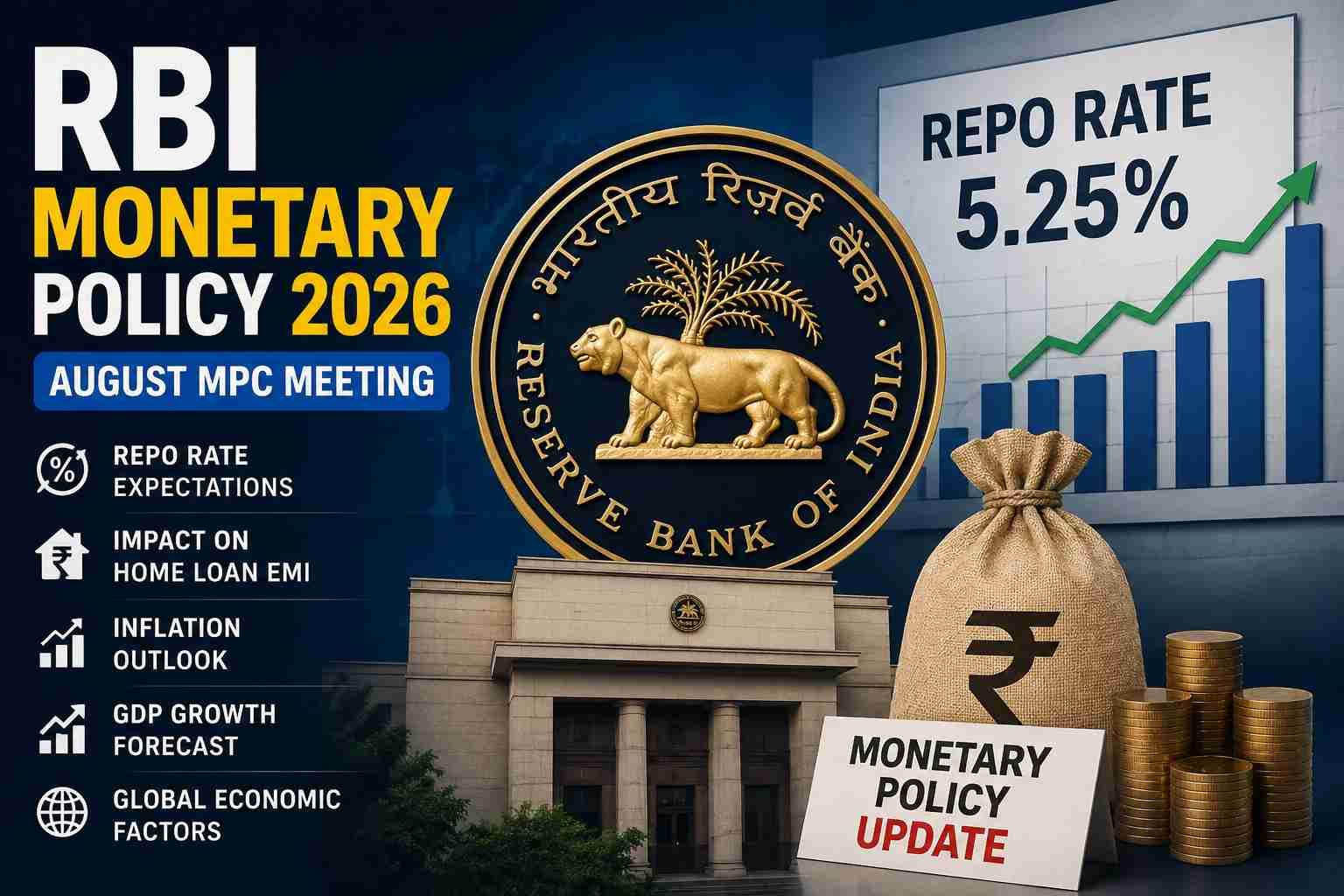
RBI Monetary Policy 2026: The RBI's August MPC meeting is expected to keep the repo rate unchanged at 5.25%, impacting loans, EMIs, inflation, and India's economy.
RBI Monetary Policy 2026: Repo Rate Decision, EMI Impact, Inflation Outlook & August MPC Meeting Explained
The RBI Monetary Policy 2026 is one of the most awaited economic announcements of the year. From the repo rate at 5.25% to home loan EMI impact, FD rates, GDP forecast and the August MPC meeting — here is everything borrowers, investors and businesses need to know.

The Reserve Bank of India (RBI) has begun its August 2026 Monetary Policy Committee (MPC) meeting, one of the most closely watched economic events of the year. The three-day meeting, which started on August 3, will conclude on August 5, when RBI Governor Sanjay Malhotra will announce the latest monetary policy decisions. Since this is the first full review after the Union Budget, financial markets will study both the rate action and the Governor’s commentary with exceptional care.
Millions of Indians — including home loan borrowers, businesses, investors, fixed deposit holders, and stock market participants — are eagerly waiting for the outcome. The policy decision will determine whether interest rates remain unchanged or whether the central bank decides to alter its monetary stance in response to inflation, economic growth, and global uncertainties. Financial experts widely expect the RBI to maintain the current repo rate at 5.25%. However, the Governor’s comments on inflation, liquidity, and future policy direction will be equally important. This article explains everything you need to know about the RBI Monetary Policy 2026, its expected decisions, the reasons behind them, and how they could affect your finances.
RBI Monetary Policy 2026: What is It?
The Monetary Policy is the strategy used by the Reserve Bank of India to manage the country’s money supply and maintain economic stability. Through this policy, the RBI regulates interest rates and liquidity in the banking system. The central bank aims to achieve two important objectives: control inflation and support economic growth. These two goals sometimes pull in opposite directions, which is why every policy review involves careful balancing.
To achieve these goals, the RBI uses several monetary tools. The most important of these is the Repo Rate. Other tools include the reverse repo rate, Cash Reserve Ratio (CRR), Statutory Liquidity Ratio (SLR), and open market operations. The Monetary Policy Committee (MPC), consisting of six members, meets every two months to evaluate economic conditions and decide whether changes in interest rates are necessary. Each of the six members has one vote, and the RBI Governor holds the deciding vote in case of a tie. The MPC’s decisions are announced through a structured statement followed by a press conference.
What is the Repo Rate?
The Repo Rate is the interest rate at which commercial banks borrow money from the Reserve Bank of India. It is often described as the anchor of interest rates in the entire economy, because nearly every lending rate in the country is connected to it. When the RBI increases the repo rate:
- Home loans become more expensive
- Car loans cost more
- Business borrowing becomes expensive
- Inflation generally slows down
When the RBI reduces the repo rate:
- Loan EMIs become cheaper
- Borrowing increases
- Spending rises
- Economic activity receives support
Therefore, every RBI monetary policy decision directly impacts households and businesses across India. Even a small change of 25 basis points can translate into thousands of rupees in annual interest for a large loan.
Why is the August 2026 MPC Meeting Important?
The August policy meeting comes at a crucial time. India continues to remain one of the fastest-growing major economies. However, global economic conditions remain uncertain due to geopolitical tensions, fluctuations in crude oil prices, and changing interest rate policies by major central banks around the world. The RBI must carefully balance inflation control without slowing India’s economic growth.
This policy review is also important because it takes place after the Union Budget announcements. Economists will be watching whether the RBI endorses the government’s fiscal assumptions and whether it signals any changes in liquidity management. The tone of the policy statement, the GDP projection, and the inflation forecast together shape market expectations for the next six months. This makes the August policy announcement particularly significant.
Our monetary policy must continue to be flexible and data-driven, responding to evolving inflation dynamics while supporting durable growth.
— RBI Governor Sanjay Malhotra’s stated policy approach
Repo Rate Likely to Remain Unchanged
According to market analysts and economists, the RBI is expected to keep the repo rate unchanged at 5.25% during the August 2026 policy meeting. A pause in the rate cycle does not mean inaction. Instead, it signals that the RBI wants to observe how existing conditions unfold before committing to any fresh move. The main reasons behind the expected hold include:
- Inflation remains within the RBI’s target range despite recent increases
- India’s GDP growth remains resilient
- Global uncertainties require a cautious approach
- Stable interest rates help maintain financial stability
- Liquidity conditions in the banking system are manageable
Instead of making immediate changes, the RBI may prefer to closely monitor future inflation trends before considering any action. A rate cut could still be on the table for later in the year if inflation cools sustainably. Likewise, if inflation surprises on the upside, the RBI has room to remain cautious for longer. For now, status quo appears to be the most likely outcome.
Inflation Remains the Biggest Concern
Inflation continues to be the most important factor influencing RBI decisions. Although food prices have shown some fluctuations, overall retail inflation has remained relatively under control. The RBI aims to keep inflation close to its target of 4%, within the tolerance band of 2% to 6%, while ensuring that economic growth is not adversely affected.
Several factors continue to influence inflation:
- Food prices
- Crude oil prices
- Weather conditions and monsoon performance
- Supply chain disruptions
- International commodity prices
- Core inflation excluding food and fuel
The Governor’s comments regarding inflation expectations will be closely watched by financial markets. Any hint that inflation could remain sticky for longer may delay hopes of a rate cut. Conversely, a confident assessment of falling food inflation could open the door for easing in later reviews. Markets also track the RBI’s quarterly inflation projection, which acts as a roadmap for future policy.
The RBI is legally mandated to keep retail inflation at 4% with a tolerance band of 2 to 6 percent. Within this framework, the MPC balances price stability with the need to support growth.
RBI Monetary Policy 2026: India’s Economic Growth Outlook
India continues to perform better than many major economies. Several sectors continue to support economic growth: manufacturing, digital services, infrastructure development, banking, government capital expenditure, and consumer spending. A stable interest rate environment encourages investment while maintaining confidence among businesses.
Economists tracking the RBI Monetary Policy 2026 expect the central bank to retain its positive growth assessment. The MPC’s GDP projection for the current financial year will be a key number to watch. A firm GDP forecast strengthens the case for keeping rates steady, since the economy does not require emergency stimulus. At the same time, the RBI is expected to acknowledge global risks such as slower world trade, volatile capital flows, and geopolitical uncertainty that could weigh on growth in the second half of the year.
The government’s focus on capital expenditure, healthy banking credit growth, and a robust domestic consumption base give the RBI room to keep a stable policy. Combined, these factors suggest the central bank will maintain a positive outlook on India’s growth prospects while remaining watchful of external headwinds.
Global Factors Affecting RBI Decisions
The RBI does not make decisions based only on domestic conditions. Several international developments influence India’s monetary policy, and the August 2026 review is no exception. Here are the most important global factors the MPC is tracking.
US Federal Reserve Policy
Interest rate decisions by the US Federal Reserve influence capital flows into emerging markets like India. When the Fed keeps rates high, global investors prefer dollar assets. When the Fed begins cutting, money typically flows back into emerging economies. Any change in the Fed’s stance affects the rupee, liquidity, and the RBI’s ability to ease policy independently.
Crude Oil Prices
India imports a significant portion of its crude oil requirements. Higher oil prices increase transportation and production costs, contributing to inflation. Since oil is priced in dollars, rising crude also widens India’s import bill and pressures the current account. Global supply decisions and geopolitical events therefore play a direct role in the RBI’s inflation calculations.
Global Geopolitical Tensions
International conflicts and trade uncertainties can disrupt supply chains and affect commodity prices. From food grains to industrial metals and energy, disruption in any major producing region eventually reaches Indian consumers. This makes geopolitical risk an unavoidable input in monetary policy planning.
Currency Movements
The value of the Indian Rupee against the US Dollar also plays a major role in RBI policy decisions. A weaker rupee makes imports costlier and adds to inflation. The RBI manages volatility in the forex market, which ties up rupee liquidity and influences overall money market conditions. The MPC’s view on currency stability is therefore closely read by investors.
Impact on Home Loan Borrowers
One of the biggest questions for ordinary citizens is whether their home loan EMI will change. If the RBI keeps the repo rate unchanged, existing EMIs are expected to remain stable. New home loan interest rates are also likely to stay at current levels, and banks may continue offering competitive lending rates to attract borrowers.
Borrowers with floating-rate loans are especially interested in RBI announcements because any future rate change can directly affect their monthly repayments. Under the current external benchmark system, most floating home loans are linked directly to the repo rate. This means even a 25 basis point change in the repo rate translates almost immediately into a change in the borrower’s EMI or loan tenure. For a typical ₹40 lakh home loan over 20 years, each 0.25% rate change can alter the EMI by roughly ₹650 to ₹700. That is why homeowners track every MPC meeting closely.
| Loan Type | If Repo Rate Unchanged | Outlook |
|---|---|---|
| Home Loans | EMIs remain stable | Competitive offers continue |
| Personal Loans | Rates stay at current levels | Favourable conditions persist |
| Car Loans | EMIs unlikely to rise | Financing remains easy |
| Education Loans | No immediate change | Affordable for students |
Impact on Personal Loans, Car Loans and Fixed Deposits
Personal loan and vehicle loan interest rates are also linked to broader interest rate movements. If the repo rate remains unchanged, car loan EMIs are unlikely to increase, personal loan rates may remain stable, and consumer financing conditions are expected to remain favourable. Banks competing for retail customers may even offer seasonal discounts and festive offers later in the year.
Fixed Deposit (FD) investors also closely monitor RBI policy announcements. If the repo rate remains unchanged, FD interest rates are expected to remain stable, existing deposits will continue earning contracted interest, and banks may avoid major revisions to deposit rates in the short term. Senior citizens who rely on FD income are particularly interested in these policy decisions, as are investors who plan to lock in current rates before any future decline. For retirees, a stable FD rate environment provides predictable monthly income and peace of mind.
Impact on the Stock Market
The stock market usually reacts quickly to RBI monetary policy announcements. Investors analyze not only the repo rate decision but also the Governor’s speech. Key sectors that could react include banking, financial services, real estate, automobiles, and infrastructure. If the RBI maintains a positive growth outlook, investor confidence could improve. Banking stocks typically move on any liquidity or rate signals, while rate-sensitive sectors like real estate and autos respond to the outlook for borrowing costs.
However, any unexpected comments regarding inflation or future tightening could create short-term market volatility. Since much of the market reaction is driven by expectations, the surprise factor matters as much as the decision itself. A widely expected status quo, accompanied by a balanced statement, generally supports a calm and positive market response.
Banking Sector Outlook
Banks generally benefit from stable policy conditions. With interest rates remaining unchanged, lending activity may continue steadily, credit demand could remain healthy, and asset quality may remain stable. Banks will also closely monitor the liquidity conditions announced by the RBI. Comfortable liquidity allows banks to reduce their cost of funds, which can gradually support fresh lending at competitive rates. The RBI’s liquidity management tools, including CRR and open market operations, will therefore be studied as carefully as the rate decision itself.
What Businesses Expect
Businesses across industries are hoping for policy stability. Stable borrowing costs help companies plan investments, expand operations, hire employees, and improve production capacity. Small and medium enterprises (SMEs) especially benefit from predictable interest rate conditions, since their working capital loans and term loans are directly sensitive to the policy rate. Predictability allows firms to price their products with confidence and commit to expansion plans without fear of sudden rate shocks.
Impact of RBI Monetary Policy 2026 at a Glance
A steady repo rate at 5.25% keeps borrowing costs stable, protects savings returns and supports economic confidence.
- Home loan and car loan EMIs remain stable
- FD interest rates stay predictable for savers
- Businesses can plan investment with confidence
- Stock markets react favourably to stability
- Banks maintain healthy lending and deposit growth
- Inflation and growth remain in balance
What Investors Should Watch in the Governor’s Speech
Apart from the repo rate decision, investors will carefully analyze the RBI Governor’s speech. Important areas include inflation outlook, GDP growth forecast, liquidity management, global economic risks, the future monetary policy stance, banking system liquidity, and financial stability measures. Sometimes the Governor’s comments have a bigger impact on financial markets than the repo rate itself.
Specific phrases also carry meaning. Words like “neutral”, “accommodative”, or “withdrawal of accommodation” signal the direction of future policy. If the Governor signals that the next move is likely to be a cut, bond yields and bank stocks may react immediately. On the other hand, any caution about inflation could push markets to push back their expectations of easing.
Possible Future Scenarios
Although the August policy is expected to maintain current interest rates, future meetings may depend on several factors: rising inflation, food prices, monsoon performance, global crude oil prices, US Federal Reserve decisions, and economic growth momentum.
If inflation remains under control, future rate cuts could become possible. In such a scenario, home loan borrowers could finally see relief in their EMIs, businesses could borrow more cheaply, and equity markets could rally on the prospect of lower interest rates. If inflation rises sharply, the RBI may consider tightening monetary policy instead. A hike would push borrowing costs higher, slow down credit growth, and put pressure on asset-heavy sectors.
Market expectations currently lean toward a shallow easing cycle if conditions permit. However, the RBI’s data-driven approach means every upcoming data release — retail inflation, industrial production, and quarterly GDP — will help decide the direction. Borrowers and investors should therefore watch the policy statement today and the data flow in the months ahead.
Why Every Citizen Should Care About RBI Monetary Policy
Many people believe RBI policy only affects banks. In reality, it influences almost every household. The RBI’s decisions affect home loan EMIs, education loans, personal loans, car loans, fixed deposits, business borrowing, investment returns, stock market performance, and overall economic growth. This is why every RBI policy announcement receives nationwide attention.
Even those without any loans or investments are affected indirectly. Stable prices protect the purchasing power of every rupee earned. A healthy interest rate environment supports job creation and wage growth. In short, the RBI Monetary Policy 2026 is not just a technical exercise for economists — it is a decision that touches the daily financial life of every Indian family.
RBI Monetary Policy 2026: Key Takeaways
Conclusion
The RBI Monetary Policy 2026 is expected to provide stability rather than surprises. Most economists believe the Monetary Policy Committee will keep the repo rate unchanged at 5.25%, reflecting a balanced approach toward inflation and economic growth. While borrowers and investors may not see immediate changes in interest rates, the RBI Governor’s outlook on inflation, liquidity, GDP growth, and global risks will shape market expectations for the coming months.
For households, businesses, and investors alike, the August 2026 policy decision is more than just an announcement — it offers valuable insights into the direction of India’s economy. As the country continues to navigate global uncertainties while maintaining strong domestic growth, the RBI’s measured approach is likely to play a crucial role in supporting financial stability and sustainable economic development. Staying informed about each policy review is the first step toward making smarter financial decisions.
RBI Monetary Policy 2026? Frequently Asked Questions
1RBI Monetary Policy 2026: What is it?
2What is the expected repo rate in August 2026?
3Will home loan EMIs decrease after the RBI policy?
4How does the RBI policy affect fixed deposits?
5When will the RBI announce the August 2026 policy?
6Why is the RBI monetary policy important for ordinary citizens?
About the Author







2 thoughts on “RBI Monetary Policy 2026”