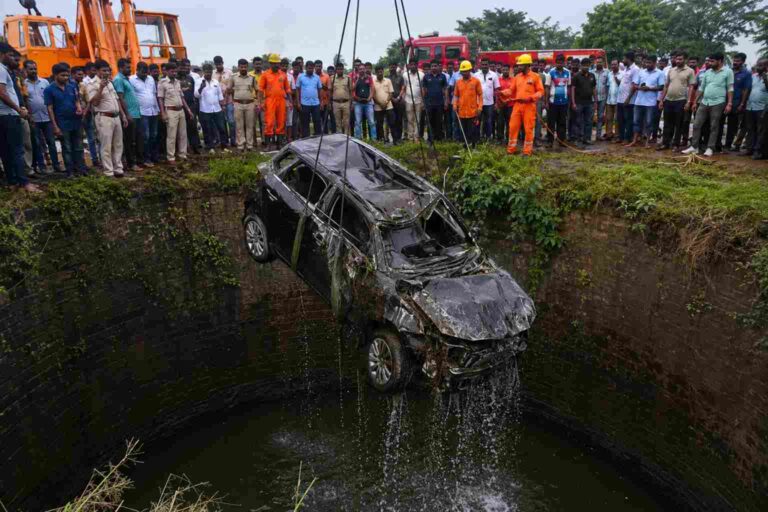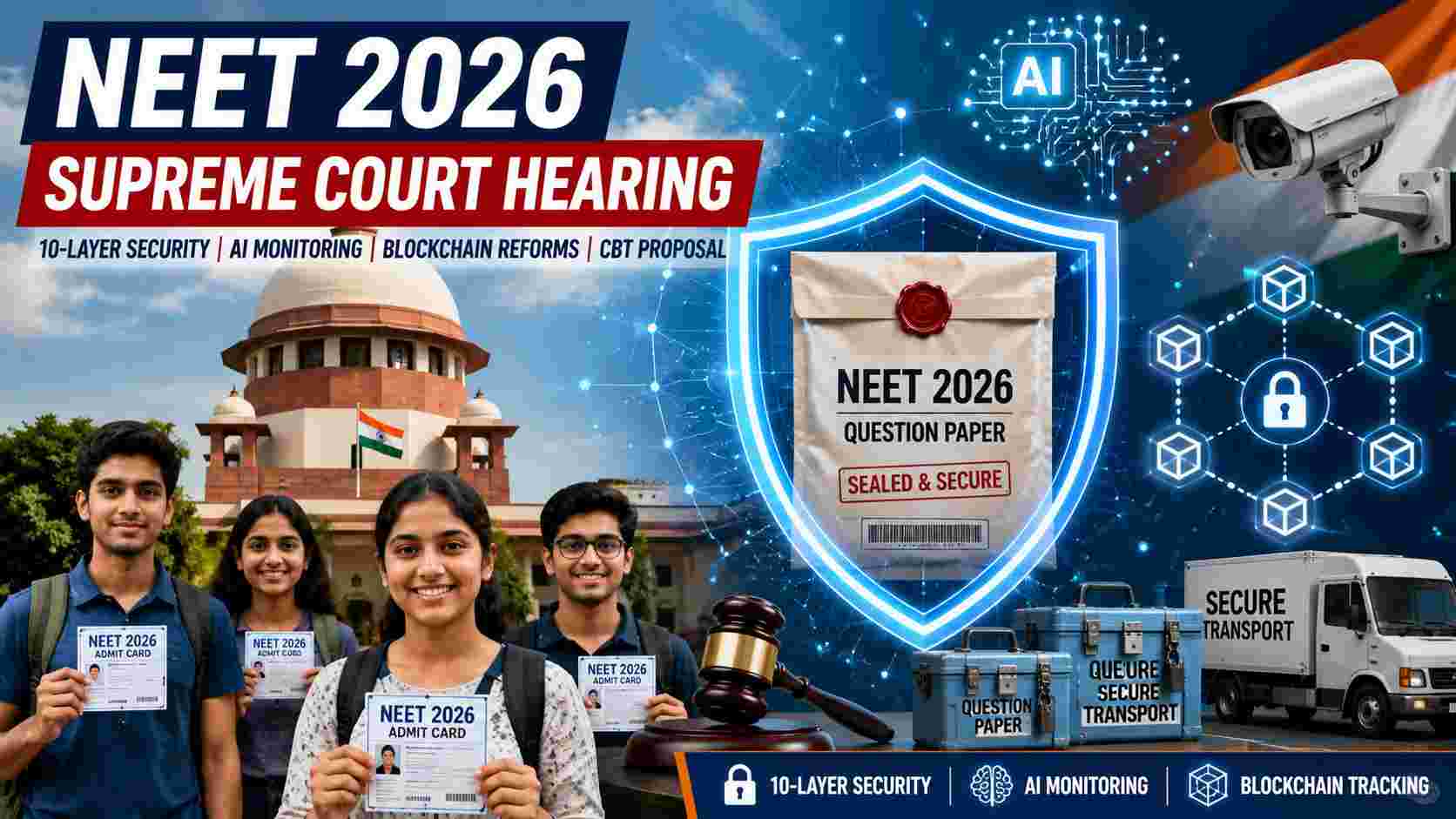
The Centre explains 10-layer security, AI monitoring, blockchain tracking, and exam reforms during the NEET 2026 Supreme Court Hearing.
NEET 2026 Supreme Court Hearing: Centre Explains 10-Layer Security, AI and Blockchain Reforms
The NEET 2026 Supreme Court hearing has become the most closely watched education case of the year. After the NEET UG 2026 paper leak controversy, the Centre has told the Supreme Court about a comprehensive 10-layer security overhaul, AI-powered monitoring and blockchain-backed tracking that promise to protect the integrity of India’s largest medical entrance examination.

Indeed, the NEET 2026 Supreme Court hearing has become one of the biggest education news stories in India. Meanwhile, millions of students, parents and educators are closely following the case because NEET is the gateway to MBBS, BDS, AYUSH and other medical courses across the country. In short, the outcome of this hearing will shape the future of medical entrance examinations for years to come. (India Today)
The hearing comes directly after the NEET UG 2026 paper leak controversy, which raised serious concerns about the security and transparency of India’s largest medical entrance examination. To restore public confidence, the Central Government has informed the Supreme Court that it has introduced a comprehensive overhaul of the National Testing Agency (NTA) examination system. This overhaul combines advanced technology with stricter security protocols. Furthermore, it covers everything from question paper printing to final distribution. Consequently, lakhs of aspirants now hope that the reforms will permanently end the menace of paper leaks.
What Is the NEET 2026 Supreme Court Hearing About?
Recently, several petitions were filed before the Supreme Court after allegations of paper leaks and irregularities during the NEET UG 2026 examination. In these petitions, candidates and civil society organisations requested the Court to examine the entire examination framework in detail. More specifically, the petitioners requested the Court to examine:
- Whether the examination system is fully secure.
- Whether the NTA has taken adequate corrective measures.
- How question papers are protected before reaching examination centres.
- What reforms are necessary to prevent future paper leaks.
In response, the Supreme Court asked the Centre to submit a detailed explanation of the entire question paper security process — from printing to distribution to candidates. Notably, the Court has made it clear that it wants a complete, step-by-step account rather than a general assurance. (LawBeat)
Examinations like NEET determine the future of lakhs of students every year. The integrity of the system must never be compromised.
— Supreme Court observation during the NEET 2026 hearing
Centre’s 10-Layer Security System Explained
During the hearing, the Central Government informed the Supreme Court that it has significantly strengthened the NEET examination process. According to the affidavit submitted before the Court, the government has implemented a multi-pronged defence that leaves no weak point in the system. Moreover, the key highlights of this new framework include:
- A 10-layer security mechanism that protects question papers at every stage.
- AI-powered monitoring systems that detect suspicious activity in real time.
- Air-gapped technology for sensitive systems that stay isolated from the internet.
- Blockchain-based tracking of examination materials for tamper-proof records.
- Stronger digital surveillance across printing, storage and examination centres.
- Better coordination between central and state authorities.
- Enhanced physical protection during the transportation and storage of question papers.
Ultimately, the Centre said these reforms are designed to eliminate opportunities for paper leaks and improve the integrity of the examination process. More importantly, the government argued that the new system ensures accountability at every single step. In other words, every official who handles sensitive material can now be tracked and held responsible. (India Today)
AI and Blockchain to Prevent Paper Leaks
One of the most important announcements during the hearing was the use of modern technology. In fact, the government’s decision to adopt cutting-edge digital tools marks a major shift from traditional examination security. For instance, the Centre informed the Supreme Court that Artificial Intelligence (AI) will help detect suspicious activities and strengthen monitoring throughout the examination process.
Blockchain technology is also being introduced to maintain secure, tamper-resistant records for sensitive examination materials. Since every entry in a blockchain ledger is permanent and verifiable, it becomes virtually impossible for anyone to alter records without leaving a trace. This is expected to improve accountability and significantly reduce the risk of unauthorized access to question papers. Together, AI and blockchain create a powerful defence against organised paper leak networks.
AI monitoring scans examination centres and digital systems for unusual behaviour, while blockchain tracking creates an unchangeable digital record of every step — from printing press to candidate desk. Air-gapped systems ensure critical data never touches the internet, removing the biggest vulnerability exploited in past leaks.
NEET 2026 Supreme Court Hearing OMR Sheet Dispute Raised by Students
Apart from the question paper security issue, several candidates also approached the Supreme Court regarding alleged discrepancies in their OMR answer sheets. Some students claimed that the scanned OMR sheets uploaded online did not match the answers they had marked during the examination. Understandably, this caused great anxiety among aspirants who feared losing marks through no fault of their own.
The petitions further urged the Court to ensure a transparent verification process so that students do not lose marks due to technical or administrative errors. The Court has taken note of these concerns while reviewing the overall fairness of the NEET examination system. Additionally, students have argued that a transparent grievance redressal mechanism is just as important as preventing paper leaks. In their view, every candidate should have an opportunity to verify their answer sheet before the final results are declared.
NTA Introduces Major Reforms
Following the controversy, the National Testing Agency (NTA) has introduced several reforms to improve the credibility of future examinations. These changes reflect a broader effort to professionalise the entire testing ecosystem. Furthermore, some of the key reforms include:
- Stronger monitoring of examination centres.
- Improved training for invigilators and officials.
- Better coordination with state governments and law enforcement agencies.
- Increased use of digital surveillance technology.
- Enhanced verification during question paper transportation and storage.
- Faster reporting and investigation of suspicious activities.
These reforms are intended to strengthen public confidence in the examination process and reduce the possibility of malpractice. Moreover, the NTA has committed to regular audits and independent checks so that weaknesses are identified and corrected before they can be exploited.
| Security Measure | What It Does |
|---|---|
| 10-Layer Security | Multi-stage protection for question papers from printing to distribution |
| AI Monitoring | Real-time detection of suspicious behaviour and anomalies |
| Air-Gapped Technology | Keeps sensitive systems isolated from external networks |
| Blockchain Tracking | Tamper-proof digital records of examination material movement |
| Digital Surveillance | Continuous CCTV and digital oversight at all sensitive points |
| State Coordination | Joint monitoring with state authorities and police |
Proposal for Computer-Based NEET (CBT)
Another important issue discussed during the hearing is the possibility of conducting NEET as a Computer-Based Test (CBT) in the future. In addition, the Centre informed the Supreme Court that expert committees are studying different examination models, including the computer-based format already used for several national entrance examinations.
Supporters of CBT believe it can:
- Reduce the risk of paper leaks.
- Improve examination security.
- Speed up result processing.
- Increase transparency.
However, the government also acknowledged that conducting NEET for lakhs of students across India through computers would require significant infrastructure and careful planning before any final decision is taken. Rural connectivity, device availability and power reliability remain major challenges. Therefore, any transition to a fully computer-based NEET is expected to be phased and gradual. (Free Press Journal)
Supreme Court Focuses on Transparency
The Supreme Court observed that examinations like NEET determine the future of lakhs of students every year. The Court is therefore examining whether:
- The new security measures are sufficient.
- Students can regain confidence in the examination system.
- The reforms proposed by the NTA are adequate.
- Additional safeguards should be introduced.
Meanwhile, the judges indicated that maintaining public trust in competitive examinations is of paramount importance. The Court will continue to review the Centre’s submissions before issuing further directions. (Careers360)
Why This Hearing Is Important
The outcome of the NEET 2026 Supreme Court hearing could influence the future of medical entrance examinations in India. It may lead to:
- Stronger security standards for question papers
- Greater transparency in result processing
- Possible transition to computer-based testing
- Reforms based on expert task force recommendations
- A template for other national-level competitive exams
What Could Change After the Hearing?
Experts believe the ongoing proceedings may lead to several long-term reforms in India’s examination system. While the exact directions from the Supreme Court are awaited, possible outcomes include:
- Even stricter security protocols for question papers.
- Greater use of Artificial Intelligence for monitoring.
- Expansion of blockchain-based security systems.
- Stronger legal action against organised paper leak networks.
- Improved transparency in answer sheet verification.
- Additional accountability measures for examination officials.
- Consideration of phased computer-based testing in the future.
If implemented successfully, these reforms could become a model for other national-level competitive examinations. Indeed, several other bodies are already watching this case closely, since its outcome may reshape how all public exams in India are conducted.
NEET 2026 Supreme Court Hearing Impact on NEET Aspirants
For students preparing for future NEET examinations, the ongoing Supreme Court hearing is expected to strengthen confidence in the examination process rather than create uncertainty. Therefore, candidates are advised to:
- Continue their preparation without being distracted by speculation.
- Follow official announcements from the NTA.
- Verify information only through reliable government sources.
- Avoid misinformation circulating on social media.
The current hearing is focused on improving the system rather than disrupting the academic calendar. Therefore, aspirants should not panic. Instead, they should use the official NTA website and trusted news portals as their only sources of truth for exam dates, admit cards and result updates.
Conclusion
In conclusion, the NEET 2026 Supreme Court hearing marks a significant step toward improving the credibility and transparency of India’s medical entrance examination system. By examining the Centre’s new security measures, proposed technological reforms and students’ concerns, the Supreme Court is helping shape the future of competitive examinations.
The government’s introduction of AI-based monitoring, blockchain-backed security and enhanced examination protocols demonstrates its commitment to preventing future paper leaks. At the same time, the Court’s scrutiny ensures that reforms are implemented effectively and that students’ interests remain protected.
Ultimately, the final directions issued by the Supreme Court could influence not only future NEET examinations but also the conduct of several other national entrance tests across India, making this one of the most closely watched education cases of 2026.
Frequently Asked Questions
1. What is the NEET 2026 Supreme Court hearing about?
2. What security measures did the Centre announce for NEET?
3. How will AI and blockchain prevent NEET paper leaks?
4. Is NEET going to become a computer-based test (CBT)?
5. What is the OMR sheet dispute in NEET 2026?
6. What reforms has the NTA introduced after the paper leak?
7. When will the Supreme Court give its final order on the NEET case?
About the Author